Not signed inFollow places and save postsSign in
Radio Travel and EatTalkBuy and SellJobs People and Culture
Aguingay

Aguingay: Under the Volcano, Chapter 2: Tagdon
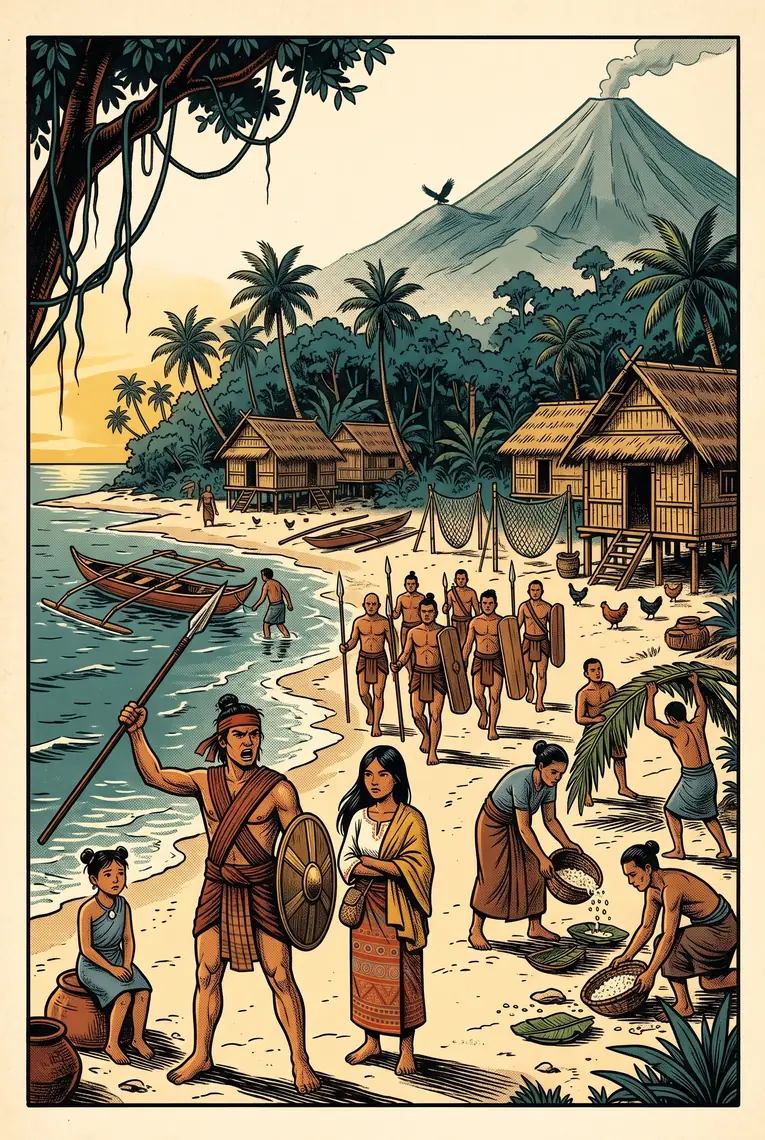
The ridge. Splash. Late afternoon, a low gold sun from the left and long shadows. Wide: the beach after the attack, seen from the edge of the village. Near, at the lower left: Bulusan stands on the sand, his spear raised point up in his right hand and his round wooden shield with a brass boss on his left arm, calling out, his face hard and set. Aguingay stands at his right, arms folded, serious. Tikling sits on an upturned clay pot behind them, worried. Middle: six other warriors in plain brown loincloths, bare heads, no headband and no sash, walk toward him with spears and long plain wooden shields. Villagers in plain brown or faded blue wraps, bare heads, lift a fallen palm-leaf arch and pick up spilled rice baskets and banana-leaf plates. In the shallows at the left, the empty outrigger boat the giant bird dropped floats upside down, and two villagers wade out to it. Far, at the upper right: the cone-shaped volcano with its thin grey plume, and on a high ridge on its shoulder the giant bird perches, a dark shape against the sky. Fishing nets dry on bamboo poles, and chickens peck under the stilt houses.
Nobody talked about the wedding anymore.Wala nang bumanggit sa kasal.
At first light, we go up that ridge.Pagliwanag, aakyatin natin ang tagaytay na 'yon.
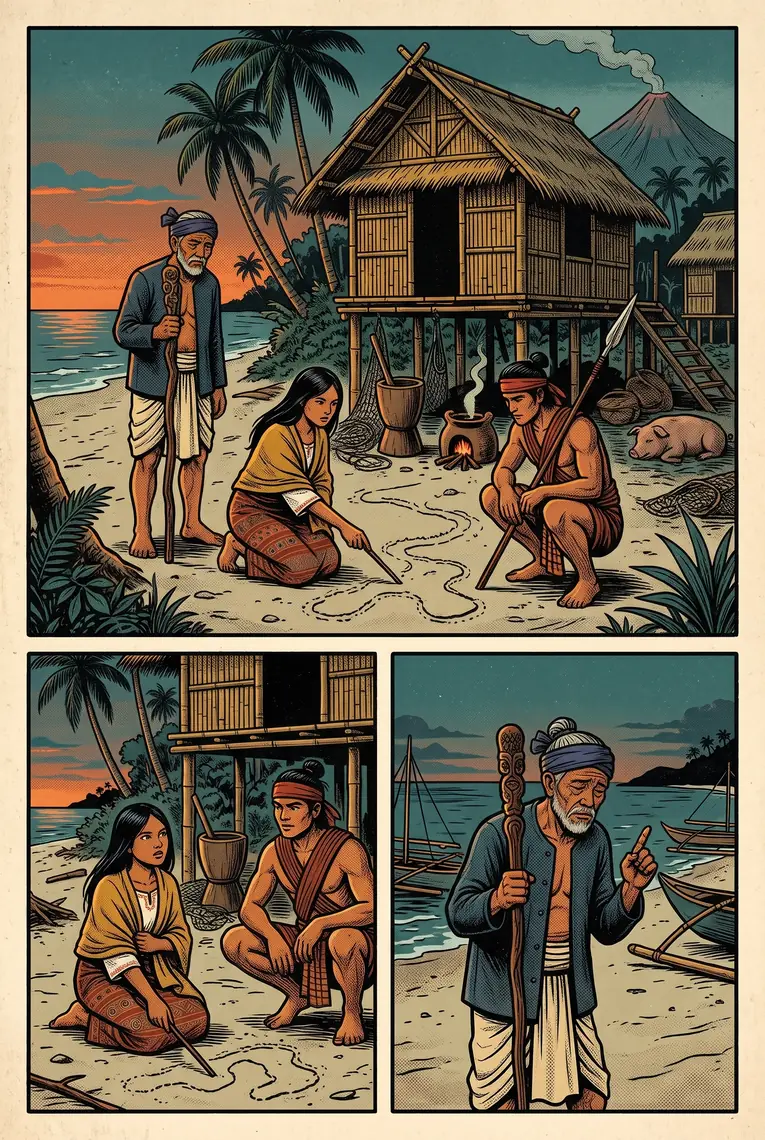
The map in the sand. Wide: dusk, an orange sky over the sea at the left. Under a big stilt house by the beach, Aguingay kneels on the sand and draws the mountain trail with a stick: a winding line, a stream, a ridge. Datu Kalaw stands at the left with his carved staff, frowning, worried. Bulusan crouches at the right, his spear across his knees, studying the lines, focused. Between the bamboo stilts behind them: a wooden rice mortar, coiled fishing nets, a clay stove with a small fire, a pig asleep. Far, at the upper right, the volcano is dark against the sky. Medium wide, from the knees up: Aguingay, still kneeling by the sand map with the stick in her hand, looks up at her father, stubborn. Bulusan, crouched at her right, nods, earnest. The stilts and the dusky beach behind them. Medium wide: Datu Kalaw, alone in the panel, leans on his staff and sighs, giving in, one finger raised in warning. Behind him, the sea at dusk and two outrigger boats with bamboo outriggers pulled up on the sand.
Draw them the trail. You're staying here.Iguhit mo na lang sa kanila ang daan. Dito ka lang.
Sand won't show them where the moss slips.Hindi kita sa buhangin kung saang lumot ka madudulas.
She's right, Datu. We'd lose half a day.Tama po siya, Datu. Masasayang ang kalahating araw.
As far as the stream. Not one step past it.Hanggang sapa lang. Huwag lalampas kahit isang hakbang.
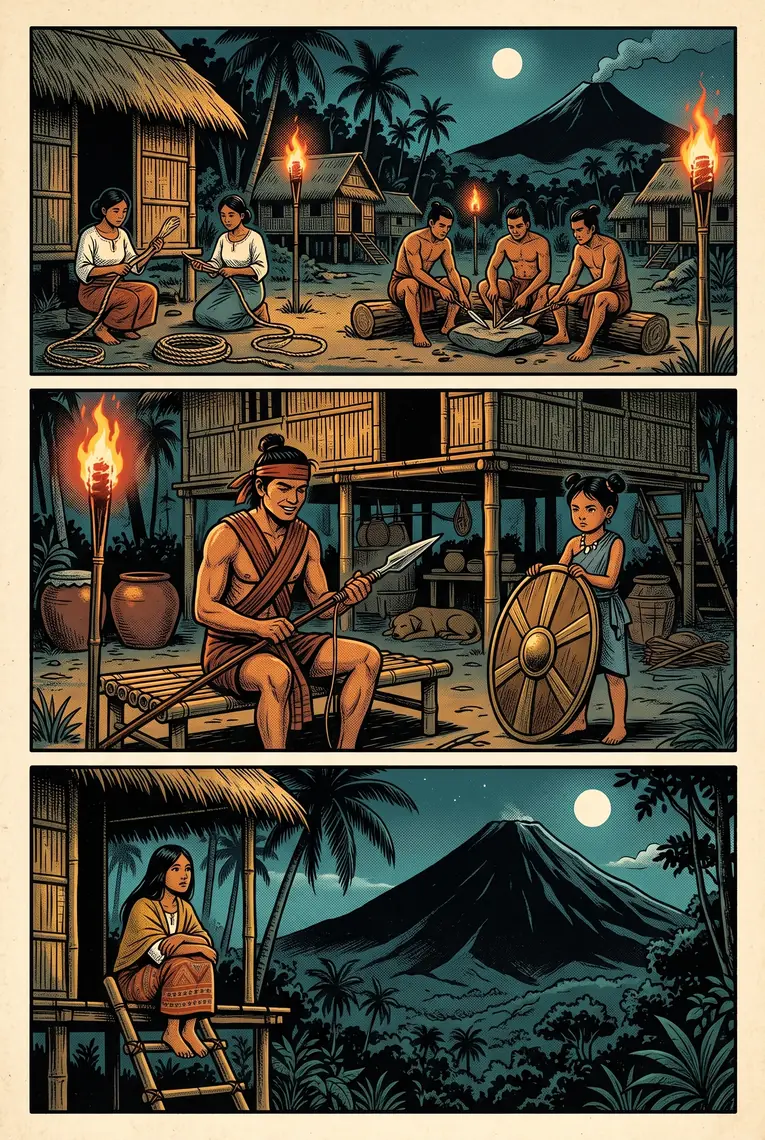
The night before. Wide: night, a bright moon. Resin torches burn on bamboo posts in the village yard. Near, at the left: two women in plain white blouses and single-colour wrap skirts twist pale abaca fibre into a long rope, a coil at their feet. Middle: three warriors in plain brown loincloths, bare heads, no headband and no sash, sit on a log and rub their spear points on a flat stone. Stilt houses with nipa roofs behind them. Far, at the upper right: the volcano, black against the moonlit sky. Wide, full body: under a stilt house, by torchlight, Bulusan sits on a bamboo bench and binds his spear head tight with cord, amused. At the right, Tikling tries to lift his round wooden shield with a brass boss off the ground with both arms; it covers her up to the chin, and she pouts. Clay jars and a sleeping dog behind them. Wide: Aguingay sits alone at the top of the bamboo ladder of a stilt house at the lower left, hugging her knees, uneasy, looking up to the right. The volcano fills the upper right, black under the moon, the ridge on its shoulder dark and empty. Coconut palms sway above the house.
Abaca is a banana relative native to the Philippines. Its fibre makes strong rope.Katutubo sa Pilipinas ang abaka, na kamag-anak ng saging at may hiblang ginagawang matibay na lubid.
Kuya, can I carry your shield tomorrow?Kuya, pahiram naman ng kalasag mo bukas?
It's bigger than you. You'd roll down the mountain.Mas malaki pa 'yan sa 'yo. Gugulong ka pababa ng bundok.
Nothing moved on the ridge. That scared her more.Walang gumagalaw sa tagaytay. Lalo siyang kinabahan.
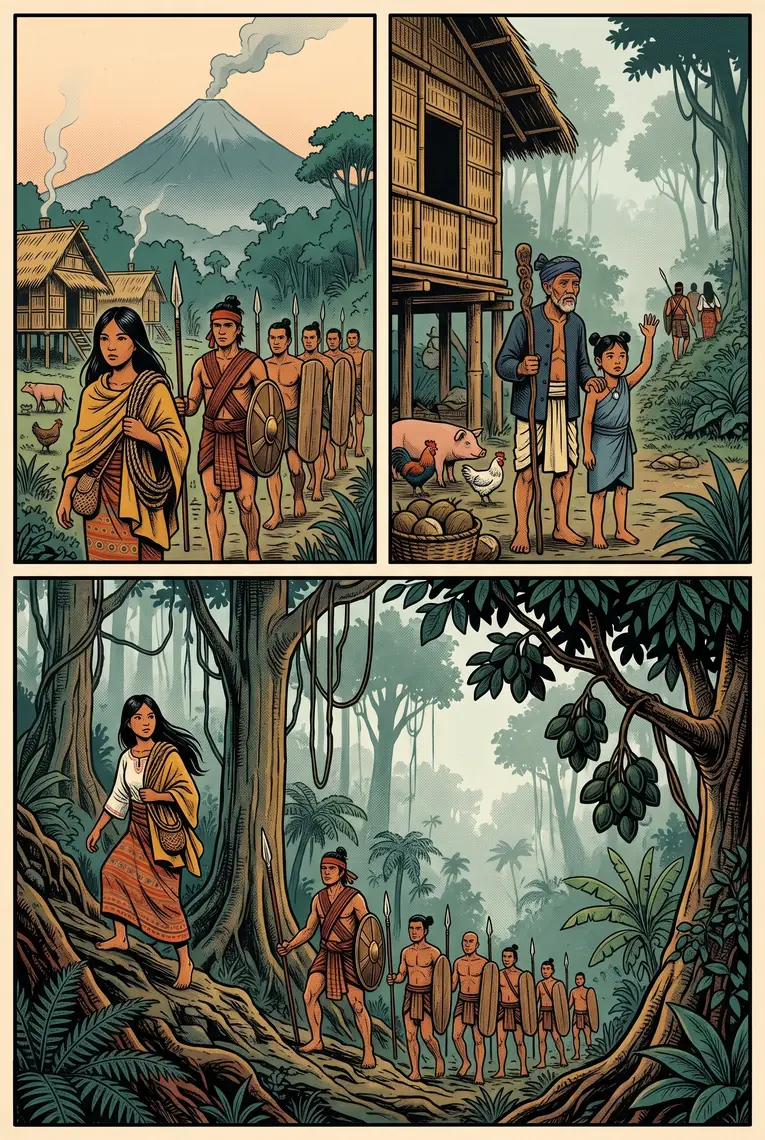
First light. Wide: dawn, a pale orange sky. A line of people walks away from the village between coconut palms toward the forest at the right, all seen full body from the side, determined: Aguingay leads, her small woven pouch at her hip and a coil of abaca rope over her shoulder; Bulusan walks behind her with his spear and round shield; behind him come six warriors in plain brown loincloths, bare heads, no headband and no sash, with spears and long plain wooden shields. At the left, stilt houses with thin smoke from cooking fires. Wide: at the foot of a stilt house at the left, Datu Kalaw stands with his staff, worried, one hand on Tikling's shoulder; Tikling waves, anxious. Both look to the right, where the small backs of the climbers go into the trees at the forest edge. Chickens, a basket of coconuts and a pig under the house. Wide: morning in the rainforest. A steep trail climbs between huge trees with buttress roots taller than a man, hanging rattan vines, tree ferns and wild banana plants. Aguingay climbs first at the upper left, sure-footed and calm; Bulusan and the six warriors follow below her in a line, small among the trunks, breathing hard. Near, at the lower right: a pili tree with clusters of dark green nuts.
They left before the roosters crowed.Umalis sila bago pa tumilaok ang mga tandang.
The pili tree is native to the Philippines. Bikol grows most of the country's pili nuts.Katutubo sa Pilipinas ang punong pili. Sa Bikol nanggagaling ang karamihan ng pili ng bansa.
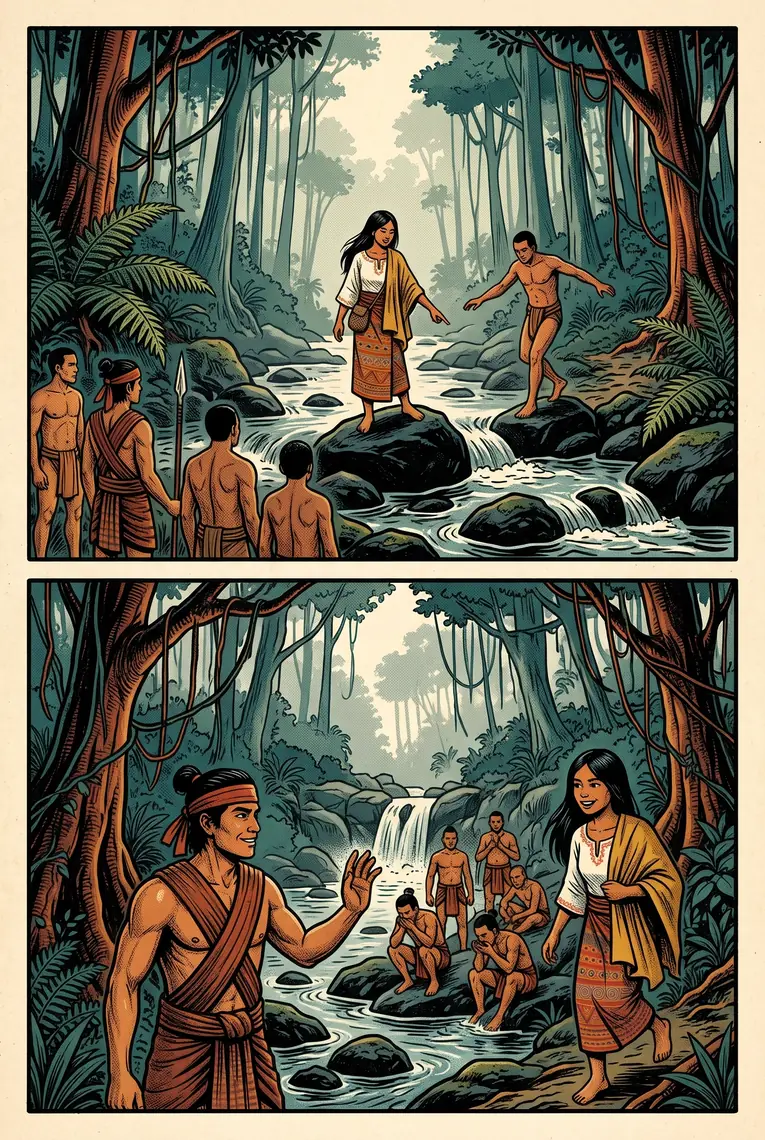
The stream. Wide: morning light through tall trees. A rocky stream crosses the trail, clear water over dark stones and green mossy stones. Aguingay stands on a dark boulder in the middle and points down at the next dark stone, confident. Behind her, one warrior in a plain brown loincloth, bare head, steps onto a dark stone with his arms out for balance, careful. Bulusan and the other five warriors wait on the near bank at the lower left. Ferns hang over the water. Wide: everyone has crossed. On the far bank, the six warriors rest on the rocks at the back and drink from their hands. Bulusan, at the left, holds up one hand to stop Aguingay, half smiling, one eyebrow up. Aguingay, at the right, grins back at him with one foot already on the trail uphill. A small waterfall upstream behind them.
Dark stones only. The green ones slide.Sa maiitim na bato lang. Madulas ang may lumot.
Here's the stream. Your father said...Ito na ang sapa. Sabi ng tatay mo...
He said a stream. There are three.Sapa ang sabi niya. Tatlo ang sapa rito.
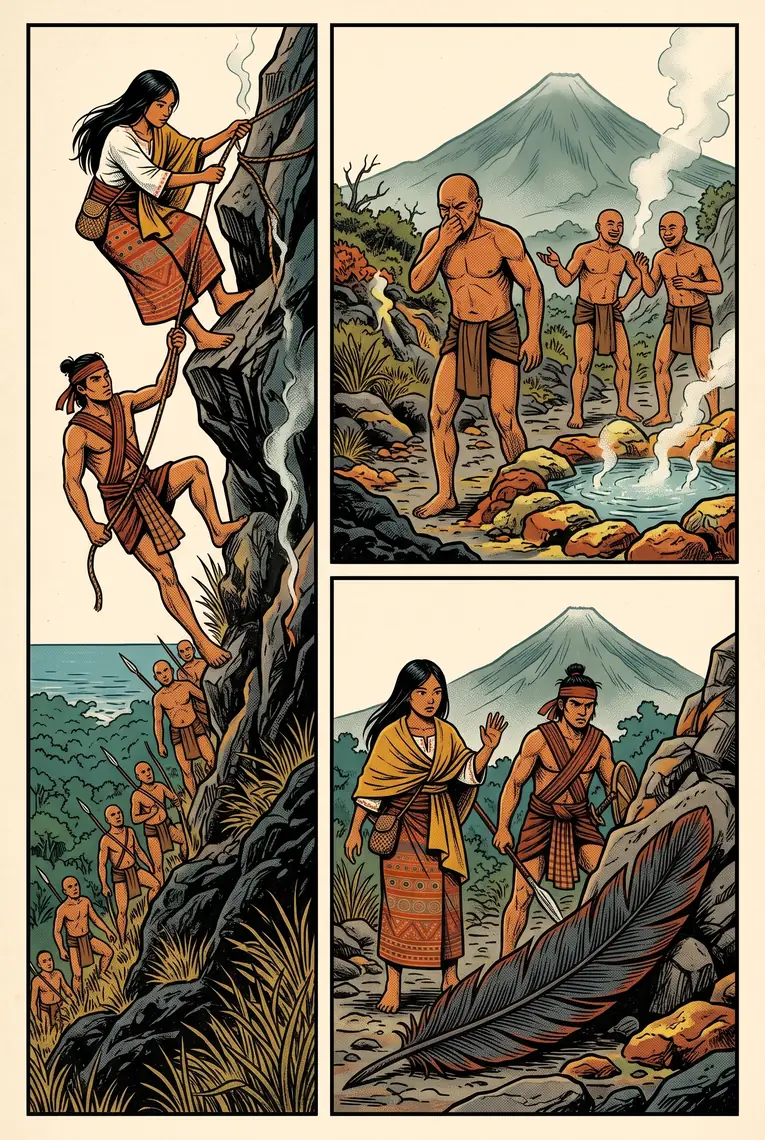
Black rock. Tall: late morning, bright and hazy. Above the last trees, the volcano slope turns to black lava rock and tough cogon grass. Aguingay climbs at the top and ties an abaca rope around a rock spur; Bulusan climbs below her, holding the rope; the six warriors climb in a line below him, small, their spears on their backs. At the bottom, far below, the green forest roof and a strip of blue sea. Thin steam rises from cracks at the right. Wide: beside the trail, a small hot spring pool steams among rust-orange stained rocks. One warrior in a plain brown loincloth, bare head, pinches his nose and pulls a face, disgusted; two more warriors behind him laugh. Wide: ahead on the trail at the left, Aguingay stops and raises one hand, alert, staring at the rocks at the right, where one huge feather lies across the stones, dark charcoal-grey edged with rust red. Bulusan comes up behind her, wary.
Above the last trees, the ground was black rock.Lampas sa huling mga puno, puro itim na bato na.
It smells like rotten eggs up here.Amoy bulok na itlog dito.
Hot springs still flow on the slopes of Mount Bulusan today.May mga mainit na bukal pa rin sa mga dalisdis ng Bundok Bulusan ngayon.
Wait. Look at the rocks.Teka. Tingnan n'yo ang mga bato.
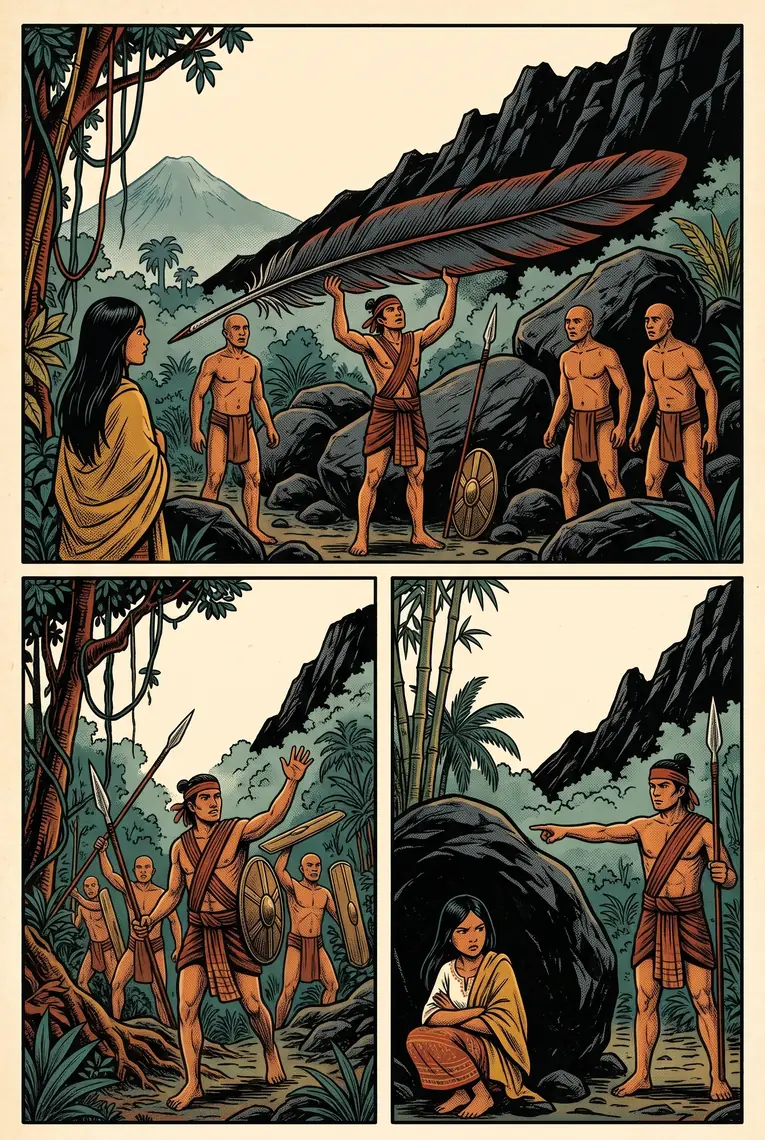
The feather. Wide: noon, a harsh white sun. The giant bird's feather lies across black rocks, longer than a man is tall, dark charcoal-grey with a rust-red edge. Bulusan lifts one end with both hands, awed; his spear and round shield lean on a rock beside him. Four warriors in plain brown loincloths, bare heads, stand around it, staring, uneasy. Aguingay, at the left, watches the high ridge, which fills the upper right: jagged black rock against the sky, nothing on it. Medium wide: Bulusan, his round shield back on his left arm and his spear in his right hand with the point up, waves the warriors forward, determined. Three warriors behind him raise their long plain shields. The ridge rises behind them at the upper right. Wide: below the ridge, behind a big black boulder, Aguingay crouches at the lower left, unhappy, arms crossed. Bulusan stands at the right and points down at the boulder with his spear hand, firm.
That's a single feather?Isang balahibo lang 'yan?
Shields up. We go together.Itaas ang kalasag. Sabay-sabay tayo.
You stay behind this rock.Dito ka lang sa likod ng batong 'to.
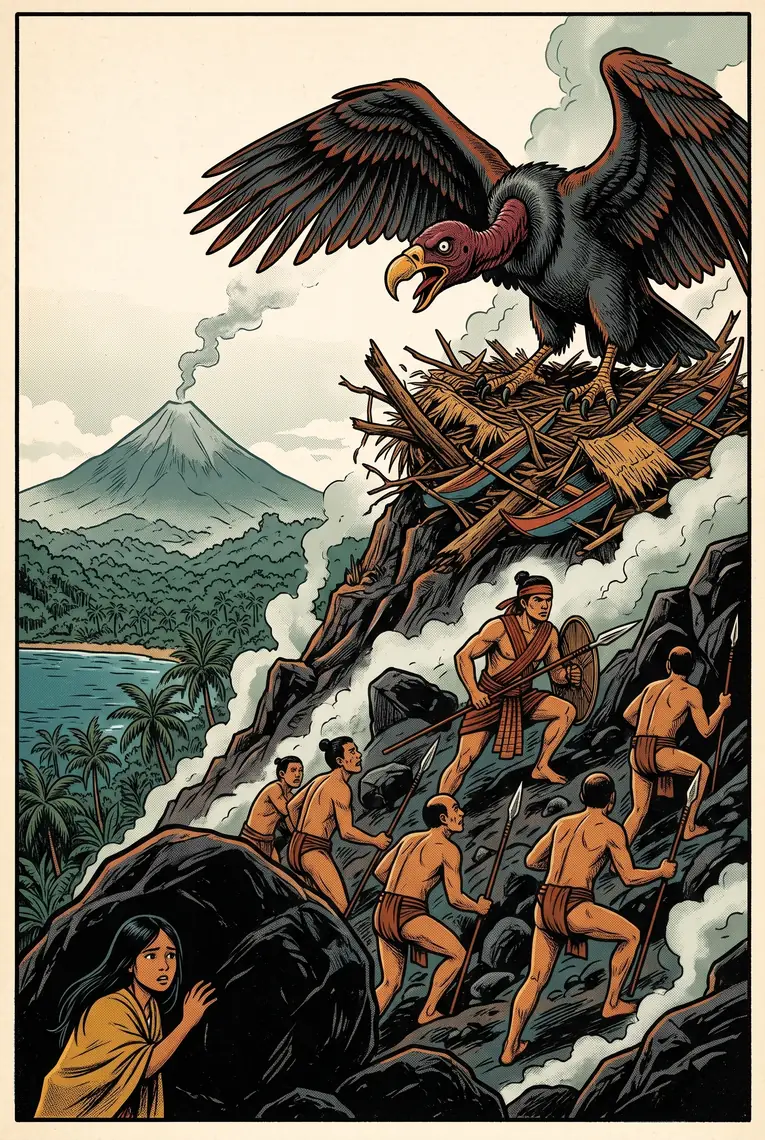
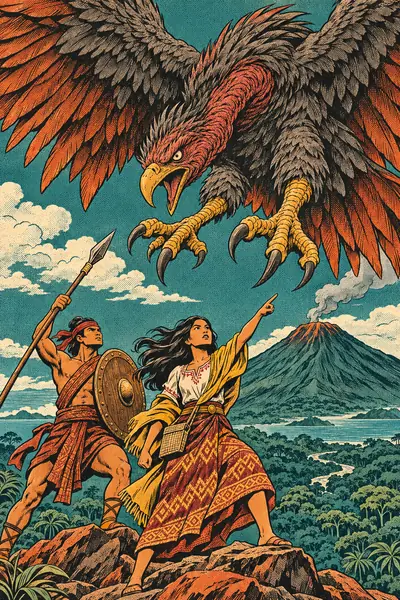
The nest. Splash. Noon, a white sky and heat haze. Wide, low angle up the slope. Upper right: on top of the ridge, the giant bird stands on a huge nest of broken tree trunks, torn nipa thatch and the snapped planks and bamboo outriggers of stolen boats. Its wings are half open, its bare dark-red neck bent, its pale eyes staring down to the lower left at the men, its hooked yellow beak open. Middle: Bulusan creeps up the black rocks in front, crouched behind his round shield, spear point forward, tense; behind him, six warriors in plain brown loincloths, bare heads, no headband and no sash, creep in a loose line, frightened. Lower left: Aguingay peers out from behind the black boulder, small and afraid. Steam drifts across the rocks. Far below at the left, the forest and the blue sea.
Mampak had heard them coming.Kanina pa sila naririnig ng Mampak.
KRRRRK...
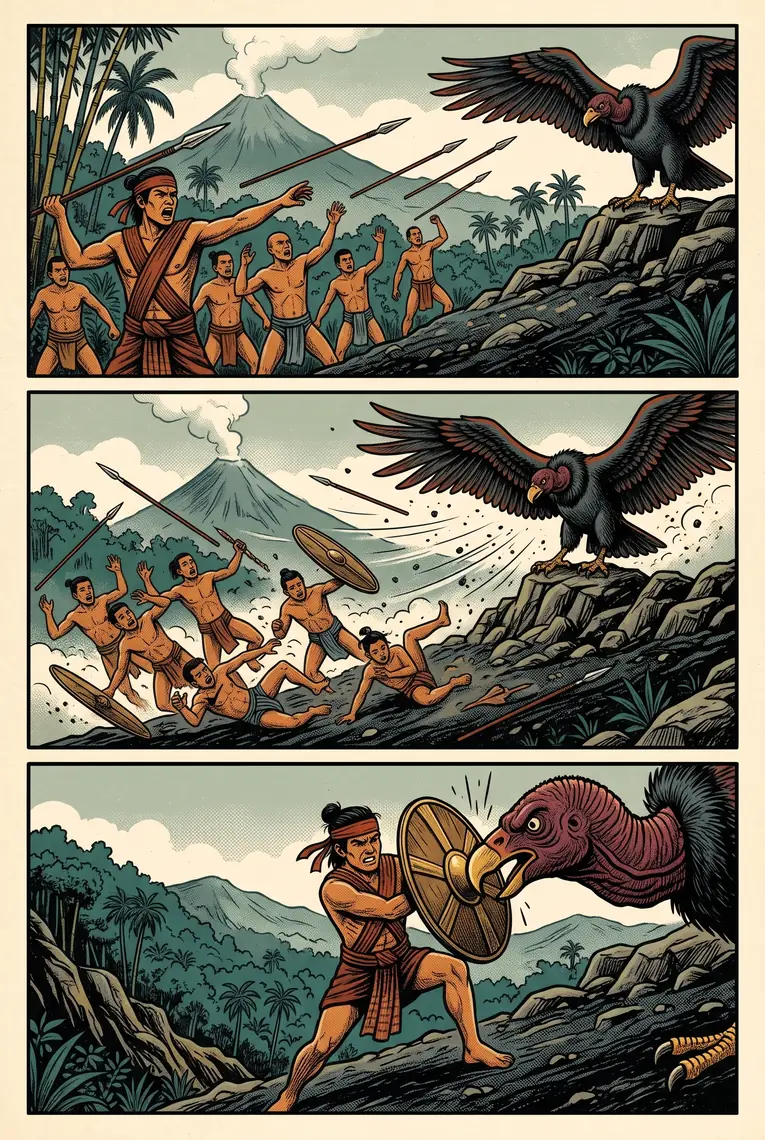
Spears. Wide: noon, the black slope below the ridge. At the lower left, Bulusan shouts and swings his spear forward to give the signal. Beside him, the six warriors throw their spears up to the right at the giant bird on the ridge at the upper right. Every spear flies point first, the points leading, up toward the bird. The men's faces are fierce and scared. Wide: the giant bird spreads its wings on the ridge at the upper right and beats them once. A blast of wind and grit knocks the six warriors off their feet at the lower left; long plain shields tumble, spears scatter, dust flies. The men are unhurt and terrified. Bulusan is not in this panel. Medium wide: Bulusan, alone on the slope just below the ridge, braces behind his round wooden shield with a brass boss as the giant bird's hooked yellow beak strikes it from the upper right. His feet dig into the black gravel, teeth clenched, straining. The bird's head and neck fill the right side; behind him, the slope drops away to the left.
Now!Ngayon na!
FWOOOM!
KRAK!
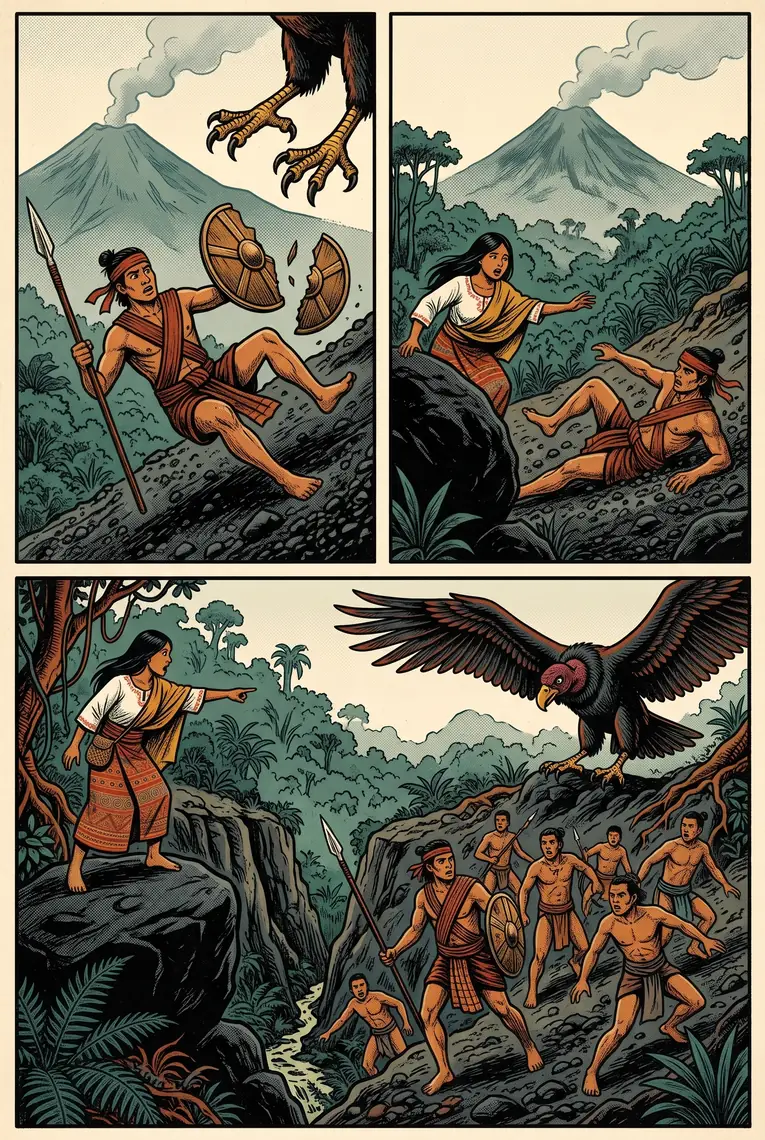
The gully. Medium wide: noon. Bulusan tumbles backward down the black gravel slope, unhurt and shocked. His round shield breaks into two halves that fly beside him; he keeps his spear in his right hand. The giant bird's yellow talons at the top right, each talon as long as a man's arm. Wide: Aguingay jumps up from behind the black boulder at the lower left, afraid, one arm out to the right toward Bulusan, who rolls to a stop on the slope at the right. Same place and same people as panel 2, same clothes worn the same way, same background: the black gravel slope below the ridge, the big black boulder at the lower left. Wide: Aguingay stands on the boulder and points down to the left, at a narrow crack of a gully full of ferns between two black rock walls, about two people wide, urgent. Bulusan and the six warriors scramble toward it from the right, panicked, Bulusan with his spear and one half of his shield. At the upper right, the giant bird hops down the ridge after them, its body as big as one stilt house, its wings half open and already wider than three houses.
Bulusan!Bulusan!
Into the gully, left! It can't open its wings in there!Sa siwang sa kaliwa! Hindi niya maibubuka ro'n ang pakpak!
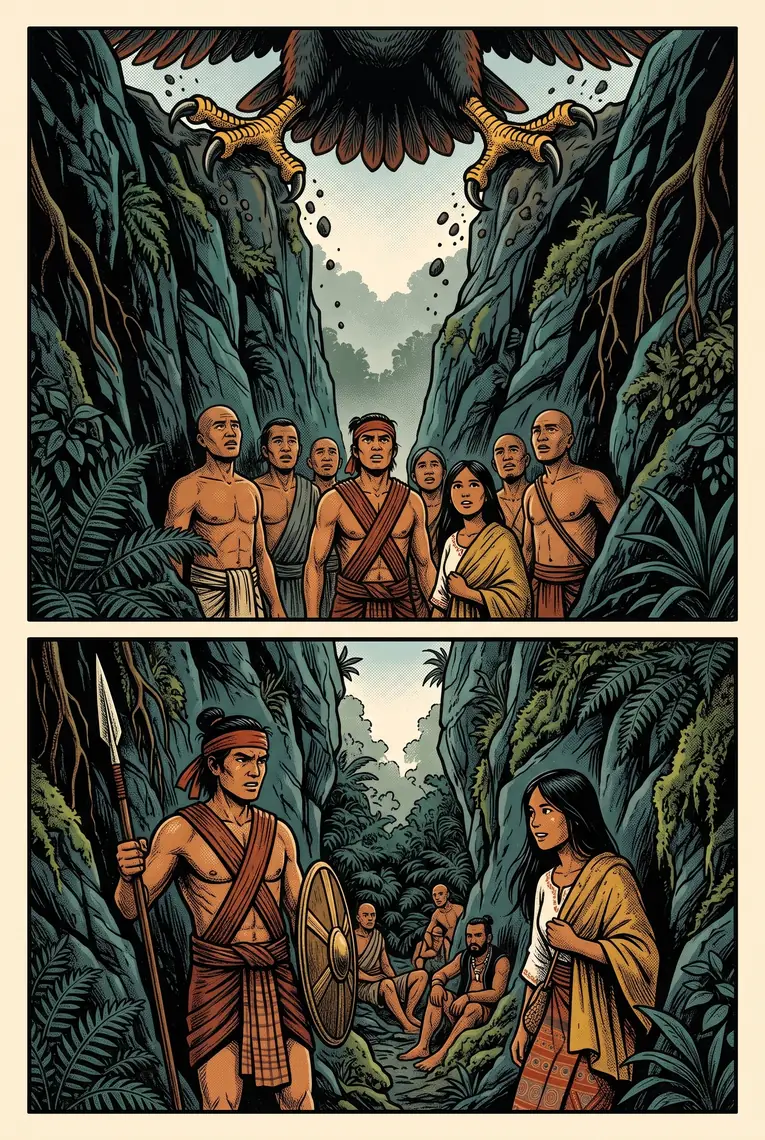
Too narrow. Wide, from inside the gully looking up: early afternoon, a narrow crack between black rock walls, about two people wide, with ferns and moss. Aguingay, Bulusan and the six warriors press their backs to the walls along the bottom, afraid, holding their breath. Across the strip of sky at the top, the giant bird's huge yellow talons scrape at the rim, too wide to reach down, and pebbles fall. Its body is as big as one stilt house, far too wide for the crack, and its wings are folded. Same place and same people as panel 1, same clothes worn the same way, same background: the narrow crack between black rock walls with ferns and moss, a strip of sky above. Medium wide, from the knees up: inside the gully, Bulusan at the left, out of breath and cross, holds his half shield and his spear. Aguingay at the right, her shawl dusty, breathes hard but gives a small tired smile. Ferns and the rock wall behind them, a slice of sky above.
SKRRREE!
I told you to stay behind the rock.Sabi ko, d'yan ka lang sa likod ng bato.
I did. Right up until you needed a way out.Nando'n nga ako. Kaso kailangan n'yo na ng daang palabas.
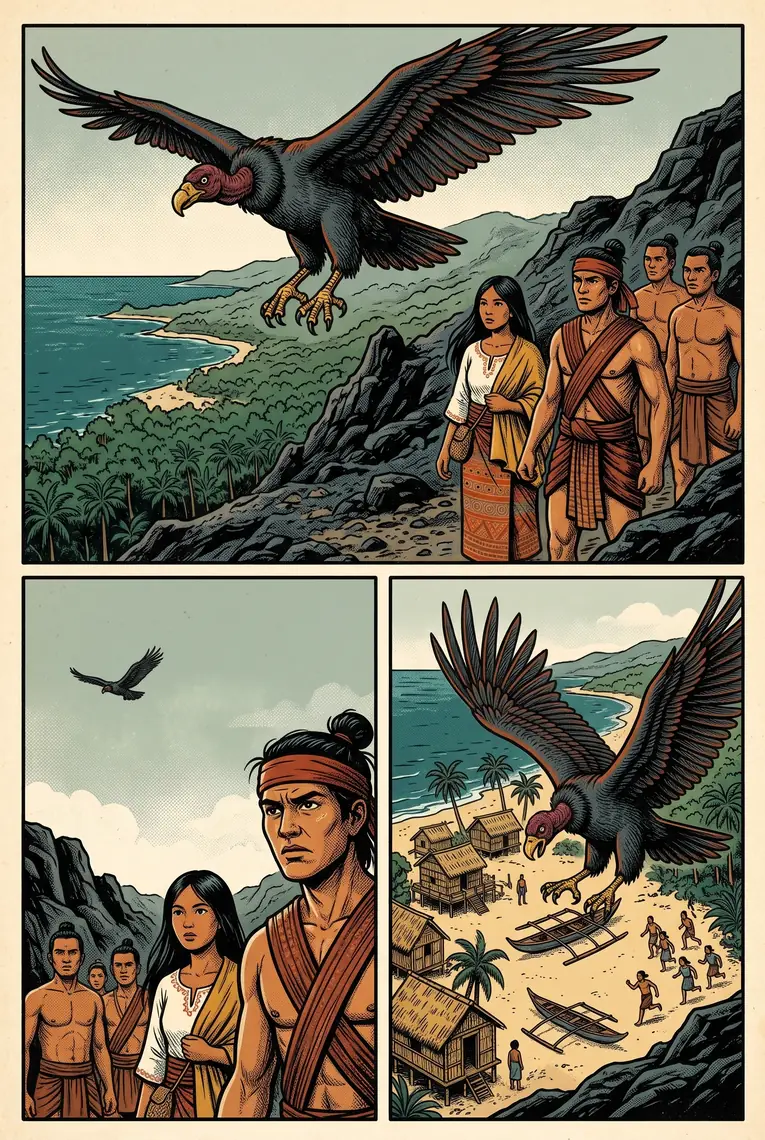
North. Wide: afternoon. At the gully mouth at the lower right, Bulusan, Aguingay and three warriors in plain brown loincloths lean out to watch, relieved. At the upper left, the giant bird lifts off the ridge and flies away to the left, north, along the green coast, its body as big as one stilt house and its spread wings as wide as five houses. The sea at the far left, the forest roof below. Same place and same people as panel 1, same clothes worn the same way, same background: the black rock at the gully mouth and the afternoon sky. Close-up: Bulusan's face at the right, grim, his eyes following the giant bird, a small dark shape far away in the sky at the left. Wide, very far: the northern coast seen from the high slope in hazy afternoon light. A small village of stilt houses, each about three people tall, and palms on a bay. The giant bird dives on it from the upper right, its body as big as one of the houses and its spread wings as wide as five houses, its talons closing on an empty outrigger boat about four people long on the beach. About ten tiny villagers in plain brown or faded blue wraps run from the beach into the trees, unhurt.
It's leaving!Aalis na siya!
It's not leaving. It's hungry.Hindi 'yan aalis. Gutom 'yan.
The villages to the north had no warning.Walang kaalam-alam ang mga nayon sa hilaga.
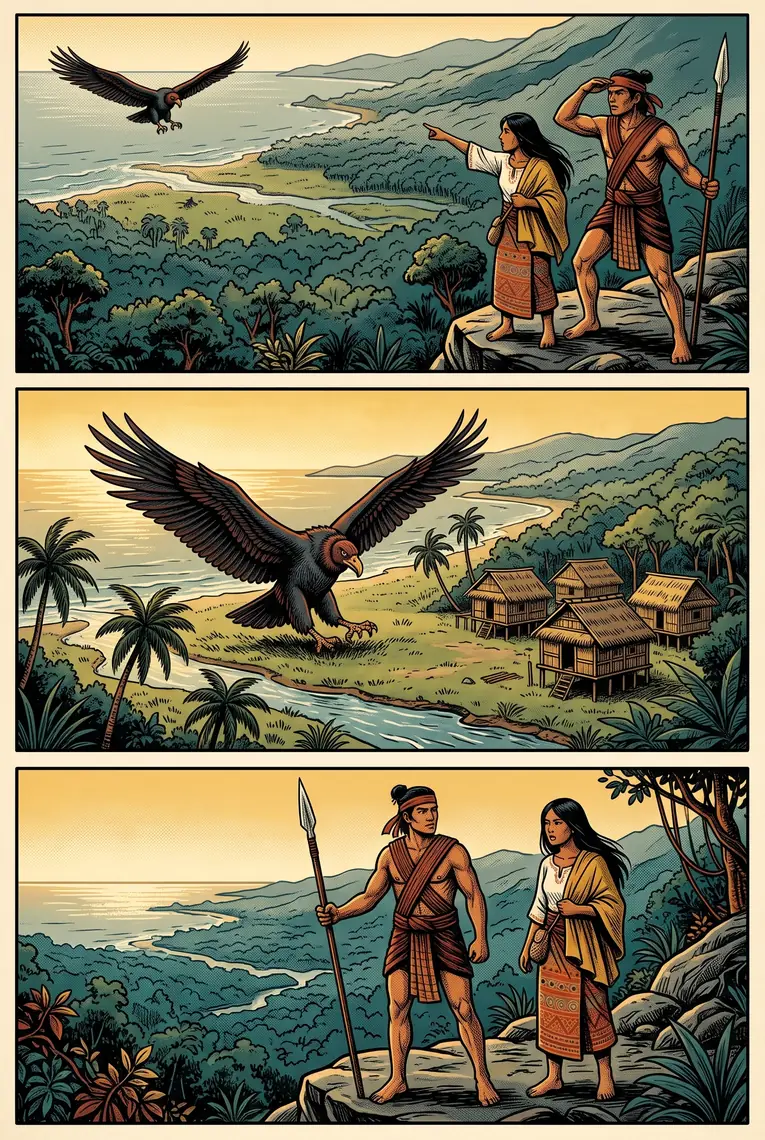
Landing. Wide: late afternoon, the light turning gold. On a high rock outcrop at the lower right, Aguingay stands and points up to the left; Bulusan stands beside her with his spear, shading his eyes, tense. Far away at the upper left, the giant bird glides down toward a grassy flat beside a river mouth on the northern coast, small with distance, its spread wings as wide as five houses. Wide, very far: the giant bird lands in the grassy flat by the river mouth, wings still spread, coconut palms bending in the wind of its wings, a few empty stilt houses, each about three people tall, at the edge. The bird's body is as big as one of those houses and its spread wings are as wide as five of them. Gold light on the water. No people. Same place and same people as panel 1, same clothes worn the same way, same background: the high rock outcrop, the gold sky, and the northern coast and river mouth tiny below. Medium wide, from the knees up: Aguingay and Bulusan on the rock outcrop. Bulusan, at the left, turns to her, hopeful. Aguingay, at the right, shakes her head, frustrated.
It's coming down. By the river mouth.Bumababa na siya. Sa may wawa ng ilog.
Some say the village of Tagdon, which means "landing", got its name from where the bird came down.Sabi ng ilan, sa paglapag ng ibon nanggaling ang pangalan ng nayong Tagdon, na ang ibig sabihin ay "paglapag".
Can you get us there?Kaya mo ba kaming dalhin do'n?
Two days on foot. For it, a few wingbeats.Dalawang araw kung lalakarin. Ilang kampay lang sa kanya.
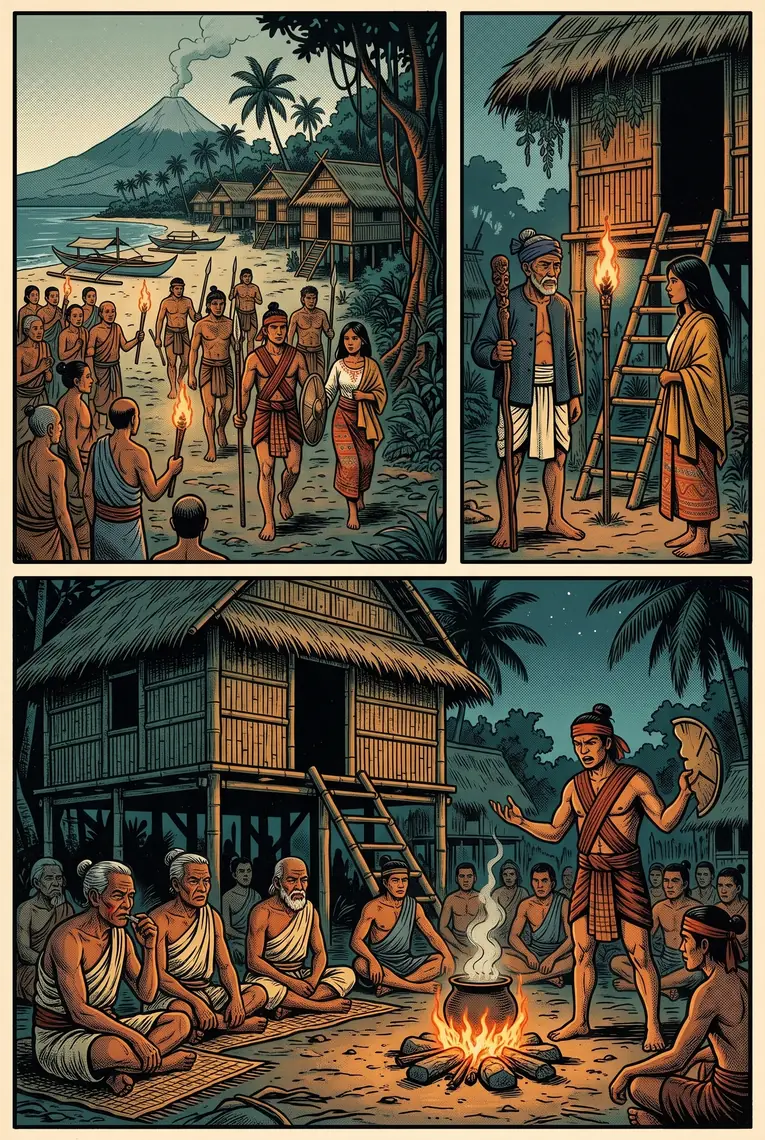
Home. Wide: dusk. The six warriors in plain brown loincloths walk into the village yard from the forest edge, tired and dusty, carrying their spears. Bulusan walks among them with his spear and one half of his broken shield; Aguingay walks beside him. About fifteen villagers in plain brown or faded blue wraps, bare heads, come out from under the stilt houses, each about three people tall, with resin torches, relieved. Coconut palms and the sea at the left. Medium wide: at the foot of a stilt house ladder, Datu Kalaw faces Aguingay, stern, his staff planted on the ground. Aguingay stands tall, tired but firm. A torch on a bamboo post burns between them. Wide: early night. A fire burns in the yard under a big stilt house, a clay pot steaming on three stones. Bulusan stands by the fire at the right and holds up his half shield, frustrated. Three grey-haired elders in plain cream wraps sit on woven mats at the left, grim; one chews betel nut, his lips red. About twelve warriors and villagers in plain brown or faded blue wraps sit around the fire. The stilt house is about three people tall.
The stream, I said.Hanggang sapa lang, sabi ko.
And they all came back, Father.At nakauwi po silang lahat, Ama.
Long before the Spanish came, people in the islands chewed betel nut with leaf and lime. It stained their lips red.Bago pa dumating ang mga Espanyol, ngumunguya na ang mga tao ng nganga na may dahon at apog, kaya pumupula ang mga labi nila.
Our spears just bounce off it.Tumatalbog lang ang mga sibat natin.
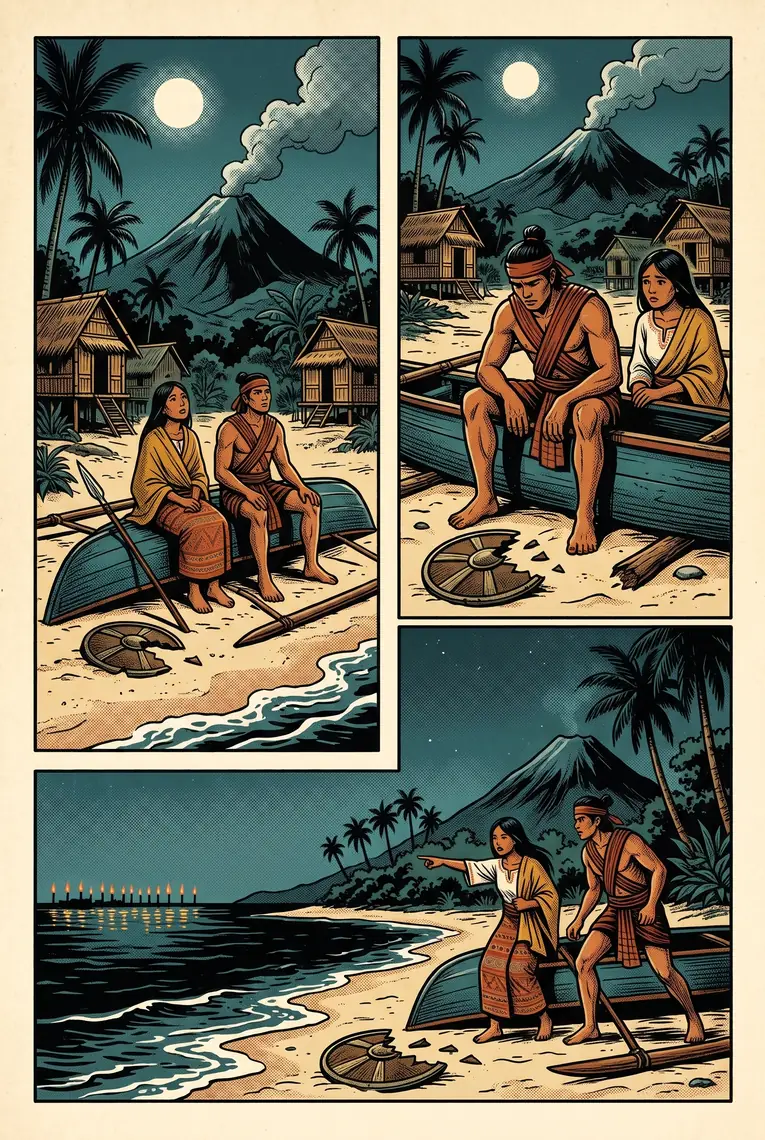
Lights on the water. Tall: night, a bright moon. On the beach, Aguingay and Bulusan sit side by side on the same empty outrigger boat the giant bird dropped, about four people long, now dragged up the sand and turned upside down. Bulusan's spear leans on the hull, and his half shield lies on the sand. Aguingay, worried, looks up at the volcano, black at the top of the panel, its ridge empty. Small waves on the sand. Same place and same people as panel 1, same clothes worn the same way, same background: the moonlit beach, the upturned outrigger boat about four people long, small waves on the sand. Medium wide: Bulusan, elbows on his knees, stares down at his broken half shield on the sand in front of him, troubled. Aguingay sits beside him at the right. Moonlight on the water behind them. Same place and same people as panel 1, same clothes worn the same way, same background: the moonlit beach, the upturned outrigger boat about four people long, small waves on the sand. Wide: Aguingay now stands by the boat and points out to sea at the left, alarmed. Bulusan, at the right, rises from the boat and looks where she points. Far out on the dark sea at the left, a long row of small torch lights on the water.
It'll come back. It knows where we are now.Babalik 'yan. Alam na niya kung nasaan tayo.
Where do I find more men by morning?Saan ako kukuha ng mas maraming tao bago mag-umaga?
Bulusan. Look at the sea.Bulusan. Tingnan mo ang dagat.
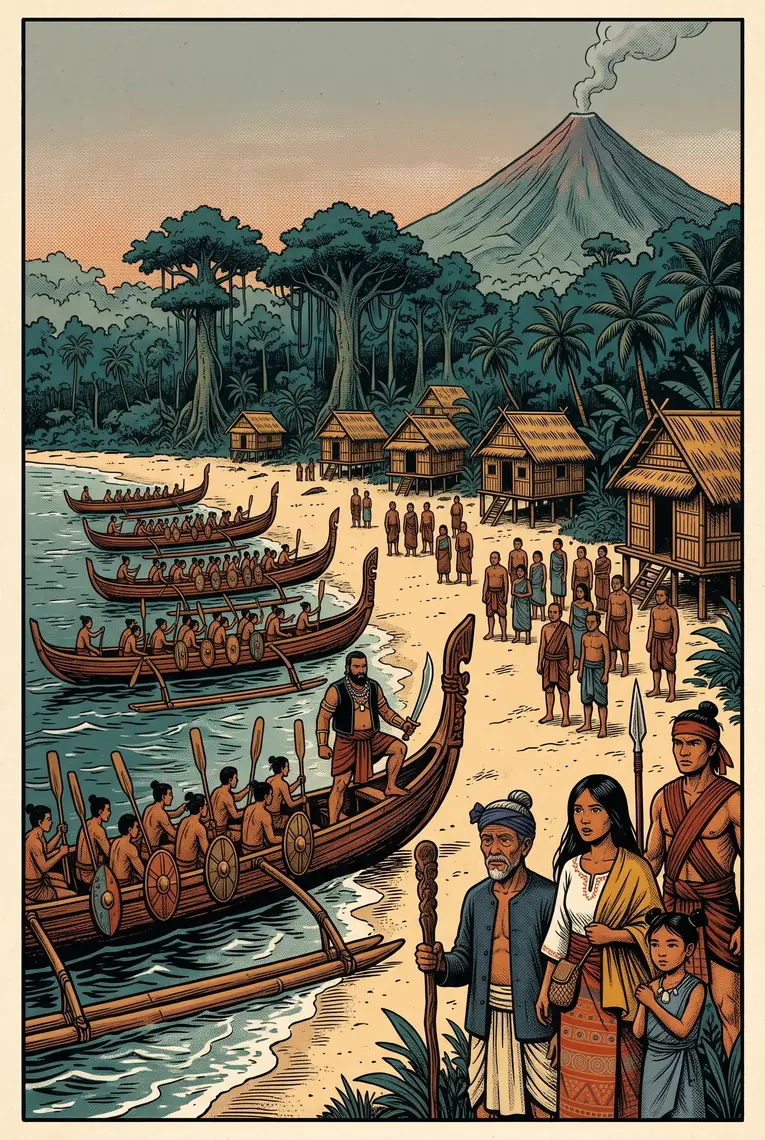
From the west. Splash. Dawn, a grey-orange sky. Wide: the beach seen from the village. At the left, seven long war boats, each about twenty people long, with double bamboo outriggers and tall carved wooden prows run up onto the sand, bows toward the right, with rows of paddlers in plain brown loincloths, paddles raised, and painted wooden shields hung along their sides. In the bow of the largest boat stands Casiguran, small at this distance, one foot on the rail, a hand on the hilt of the long curved sword at his hip, sure of himself. At the lower right: Datu Kalaw stands with his staff, wary; Aguingay beside him, alarmed; Tikling hides behind Aguingay's skirt; Bulusan stands at the right end with his spear, no shield, jaw tight. All four look left at the boats. Between the stilt houses, each about three people tall, about twenty villagers in plain brown or faded blue wraps, bare heads, stop on the sand, uneasy. Behind the village at the upper right, the volcano with its thin grey plume.
They came at dawn, from the west.Dumating sila pagbukang-liwayway, mula sa kanluran.
Those aren't fishing boats.Hindi pangisda ang mga bangkang 'yan.
End of Chapter 2.Katapusan ng Kabanata 2.

Get chapter 3 when it is out

Chapter 3, Casiguran, is not ready yet. Leave your email and we will tell you when it is out. We use it for nothing else.

Sign in to bookmark this komiks and see when a new chapter is out.

What did you think of this chapter?

0 reactions

Comments 0

Sign in to comment.

Nobody has commented yet.