Not signed inFollow places and save postsSign in
Radio Travel and EatTalkBuy and SellJobs People and Culture
Nuno sa punso

Nuno sa Punso: Tabi-Tabi Po, Chapter 8: The Workers' Fever
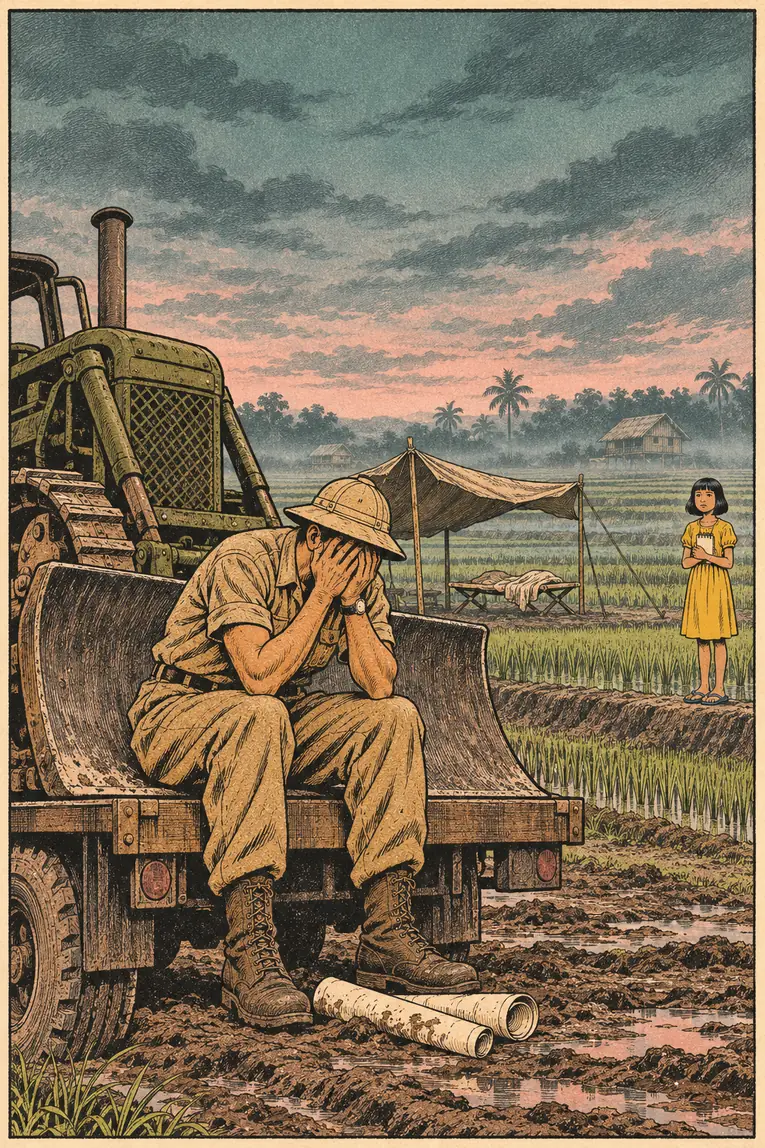
The empty blade. Splash. Saturday, dawn, outdoors at the survey camp, grey-pink sky, thin mist. Low wide shot: Engr. Dimalanta sits alone on the steel blade of the dark-green bulldozer, still on its truck, elbows on his knees and both hands rubbing his face, his rolled plans dropped in the mud at his boots, exhausted and worried. Far behind him, under a canvas awning, a single cot with a rumpled blanket. At the far right edge, small on the mud dike, Tinay stands with her notebook held to her chest, looking at him, anxious. No other person.
Berto was only the first.Si Berto pa lang ang una.
Two days left. Where do I find WORKERS?Dalawang araw na lang. Saan ako kukuha ng trabahador?
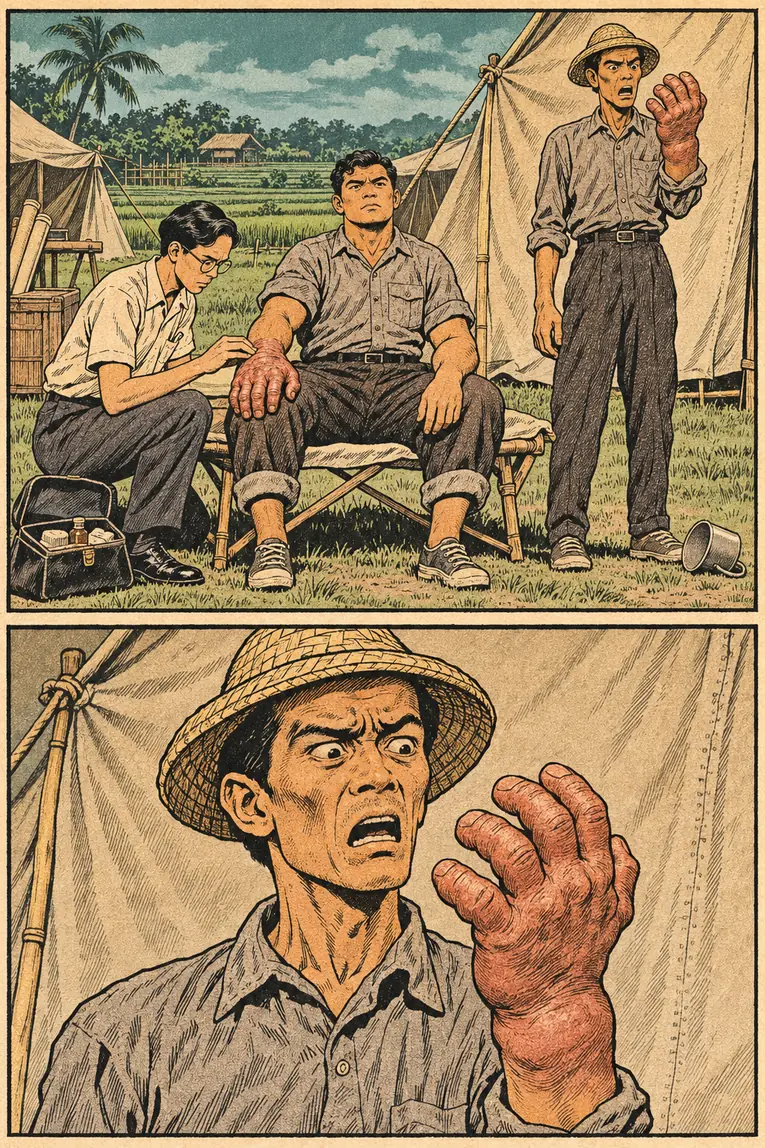
No cause. Wide: Sunday morning, outdoors in front of the survey camp tents, bright sun. Berto sits on his cot at our left, his RIGHT hand swollen on his knee. Dr. Santos kneels beside the cot holding Berto's swollen wrist and peering at the skin, puzzled, his black bag open on the ground. Ador stands at our right, facing us, a tin cup dropped at his feet and his LEFT hand held up in front of him, red and swollen round to the wrist, mouth open in fright. Close-up: same morning, outdoors. Only Ador's face, frightened, eyes on his own swollen LEFT hand held up beside his cheek; behind him only the canvas tent wall; no other person.
No bite, no cut. I can't find a thing.Walang kagat, walang sugat. Wala akong makita.
This is concerning. Isn't it, Berto?Nakakahawa ba 'to, Berto?
In the old belief, a nuno makes the body part of anyone who harms his home swell or ache.Ayon sa paniwala, pinapamaga o pinasasakit ng nuno ang bahagi ng katawan ng sumira sa tahanan niya.
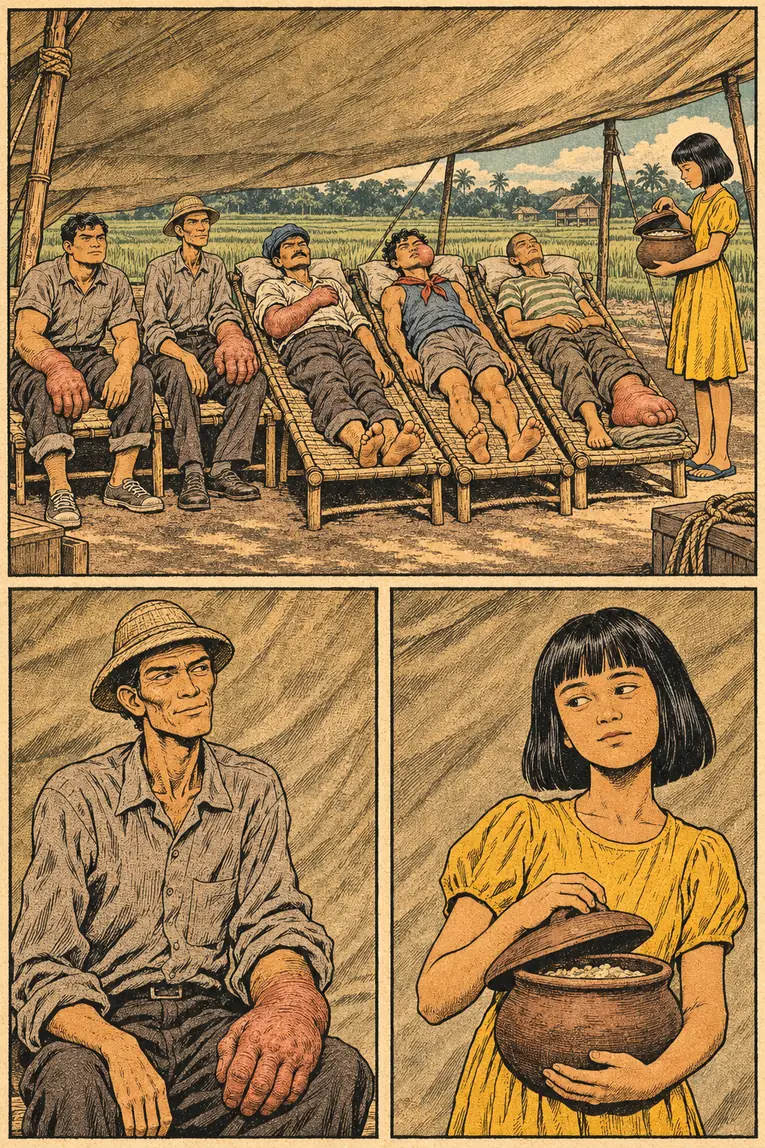
Only lugaw. Wide: Sunday afternoon, outdoors under the canvas awning of the survey camp, warm slanting light. Five cots in a row, from our left: Berto sits with his RIGHT hand swollen to the wrist; Ador sits with his LEFT hand swollen to the wrist; the worker in the blue cap lies with his RIGHT forearm swollen from wrist to elbow against his chest; the worker in the red neckerchief lies on his back with his LEFT cheek swollen round and his eye half shut; the worker in the striped shirt lies with his LEFT foot red and swollen, propped on a folded blanket. Tinay stands at our right end of the row with a clay pot, her feet and chest pointing at the cots, lifting its lid, gentle and tired. Close-up: same afternoon, outdoors. Only Ador, looking at someone off-panel on our right, a tired half smile, his swollen LEFT hand resting in his lap; behind him only the canvas awning; no other person. Close-up: same afternoon, outdoors. Only Tinay holding the clay pot in both hands, eyes sliding away from someone off-panel on our left, her notebook tucked out of sight under her arm; behind her only the canvas awning; no other person.
By Sunday, five cots were full.Pagsapit ng Linggo, lima na ang nakaratay sa katre.
You look like you know something, Tinay.Parang may alam ka, Tinay.
No, Kuya. It's just lugaw.Wala po, Kuya. Lugaw lang po 'to.
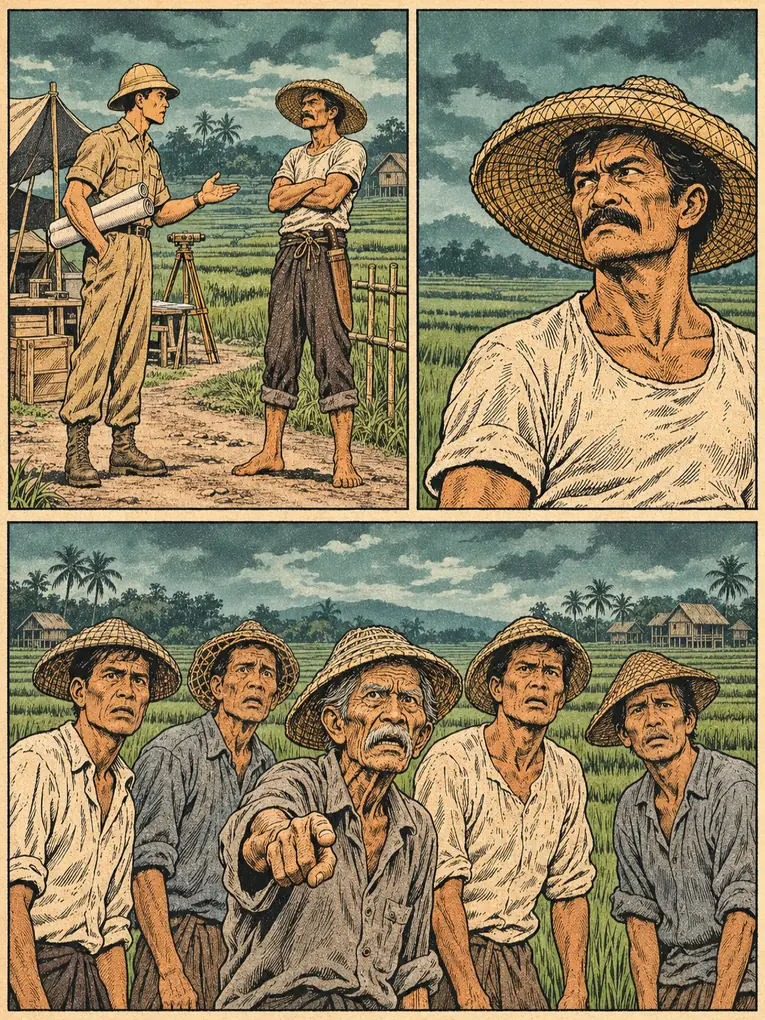
No hands for hire. Wide: Monday morning, outdoors on the dirt road beside the survey camp, bright sun. Engr. Dimalanta stands at our left, plans under his arm, his feet and chest pointing at Tatay Ramon, pleading. Tatay Ramon stands at our right in his straw hat and white undershirt with his arms folded, facing the engineer, grim and tired. Close-up: same road, same morning. Only Tatay Ramon in his straw hat, looking at someone off-panel on our left, firm and weary; behind him only the green paddy; no other person. Wide: Monday morning, outdoors at the edge of a rice paddy, a few paces off. Five farmers in straw hats and rolled trousers stand in a loose line facing us, uneasy. The oldest, a lean farmer with a grey moustache, stands at the front and points a thin finger past us toward the far-off acacia and mound, grim and afraid. No other person.
Five down, Mang Ramon. Lend me five of yours.Lima na ang bagsak, Mang Ramon. Pahiram ng limang tao n'yo.
Nobody WANTS TO TOUCH your stakes. Not now.Walang hahawak sa mga tulos n'yo. Hindi ngayon.
I left a coin at that mound once. Nothing ever ached.Nag-iwan ako ng barya sa punso. Walang sumakit sa 'kin.
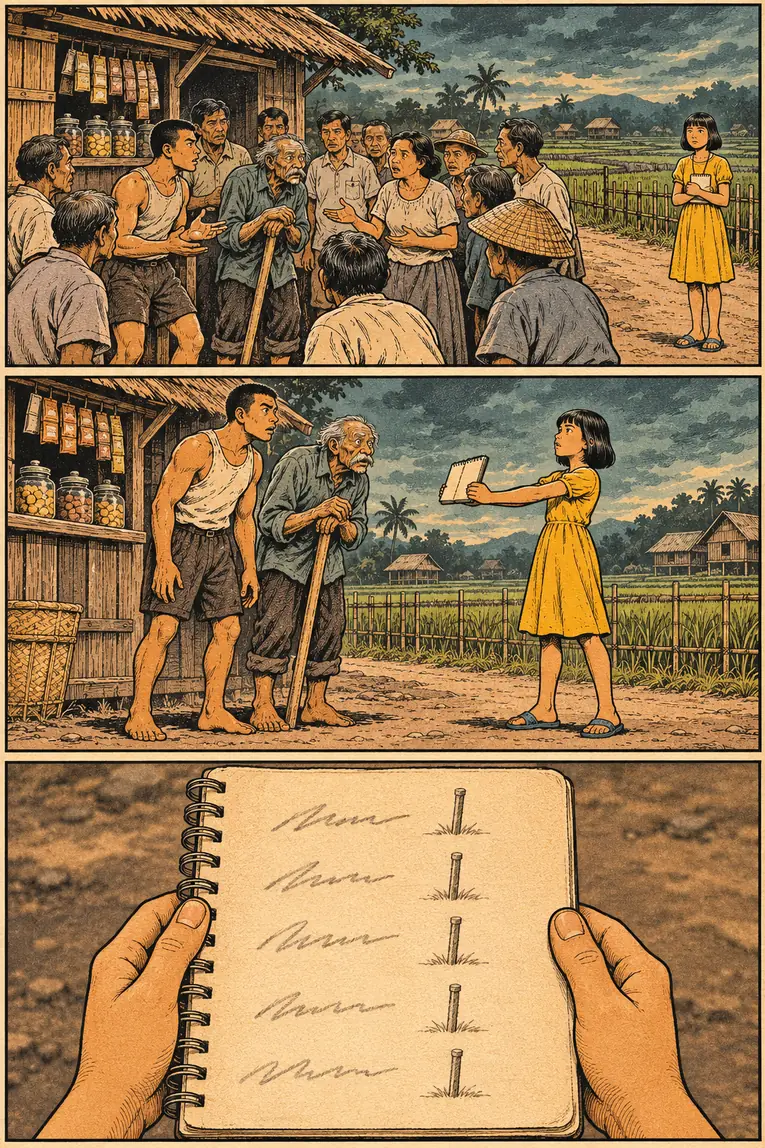
Look. Wide: Monday, late afternoon, outdoors on the dirt road in front of a plank sari-sari store with jars and hanging packets, low gold light. About a dozen villagers stand in a loose crowd, talking, anxious. Tinay stands apart at the right edge, her notebook held to her chest, looking at them, torn. Medium: same afternoon, outdoors. Tinay steps forward into the crowd, her feet and chest pointing at the villagers, holding her open notebook out at arm's length, chin up, determined and trembling. The young farmer in the sleeveless shirt and the old farmer with the grey moustache stand at the front facing her, startled. Close-up: the notebook page held open in Tinay's two small hands, warm gold light: a column of five names, each with a small pencil drawing of an iron stake beside it, five stakes in all. No readable words; no face.
Five men in two days. That's no fever.Lima sa loob ng dalawang araw. Hindi 'yan basta lagnat.
Look. Every sick man drove a stake.Tingnan n'yo po. Lahat ng may sakit, nagbaon ng tulos.
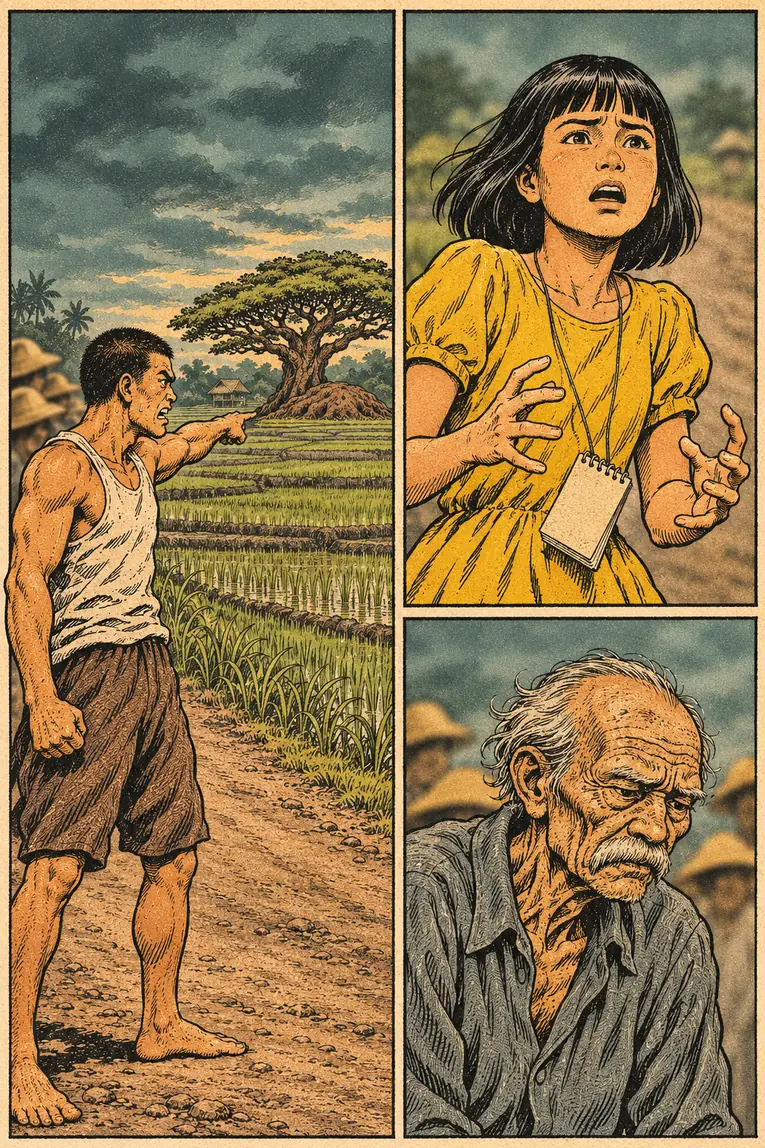
Crush him now. Tall: Monday, late afternoon, outdoors on the dirt road, low gold light. The young farmer in the sleeveless shirt stands in the left foreground, turned three-quarters away from us toward the right, so we see his angry face in profile; his arm points hard into the picture, away from us, straight at the low termite mound and the old acacia far off on the right, his arm and the mound in one line, his other fist clenched, jaw tight, furious and afraid. Behind him on the left a blur of straw hats. Close-up: same afternoon, outdoors. Only Tinay, stricken, her mouth open and her notebook slipping in her hands; behind her only the blurred road; no other person. Close-up: same afternoon, outdoors. Only the old farmer with the grey moustache, looking down at someone off-panel on our right, hard and sad; behind him a blur of straw hats; no other person.
Stakes or no stakes, he did this. He'll take us all.Tulos man o hindi, siya ang may gawa. Uubusin niya tayo.
No! That's not what I meant!Hindi po! Hindi 'yan ang ibig kong sabihin!
IHA, Your brother's leg knows.Alam 'yan ng binti ng kapatid mo, iha.
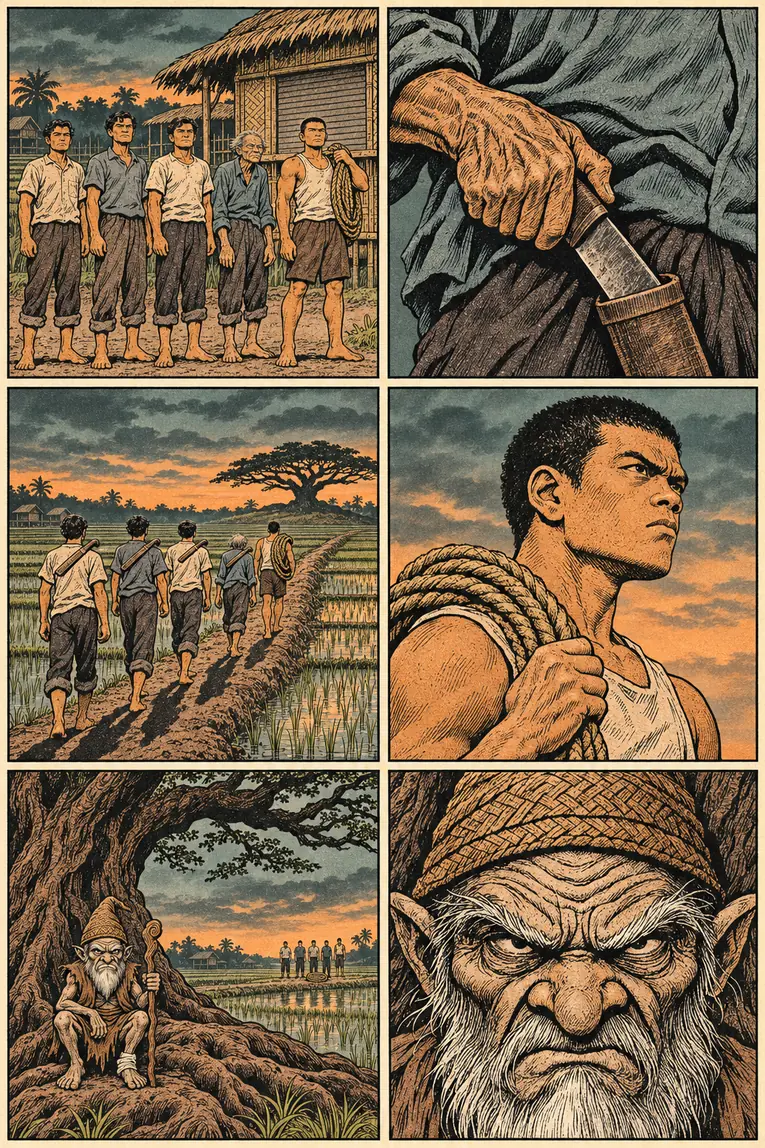
Rope and bolo. Wide: dusk, outdoors on the dirt road in front of the sari-sari store, low orange light. The crowd is gone. Five farmers stand in a line facing us, silent and grim; the young farmer in the sleeveless shirt hauls a thick coil of rope onto his shoulder. Close-up: dusk. Only the old farmer's weathered hand drawing a bolo half out of the sheath at his belt; no face and no other person. Wide: dusk, outdoors on a mud dike between the paddies. The five farmers walk in single file away from us toward the far black acacia, rope and bolos on their shoulders, long dark shadows against an orange sky. No other person. Close-up: dusk. Only the young farmer's face in profile, rope on his shoulder, his eyes fixed hard ahead, afraid under the anger; behind him a blur of orange sky; no other person. Low wide shot: dusk, at the foot of the termite mound under the black acacia. The tiny nuno stands alone on the lowest root facing us, his staff in one hand, his left ankle, the one on our right, in the white handkerchief, calm and watchful. Far behind him at the end of the dike, five tiny farmers have stopped and stand still, a coil of rope at their feet. Close-up: dusk. Only the nuno's eyes narrowing under his bushy white brows, wary and unafraid; behind him only the dark trunk of the acacia; no other person.
At the edge of his field, nobody took another step.Sa gilid ng bukid niya, wala nang gustong humakbang pa.
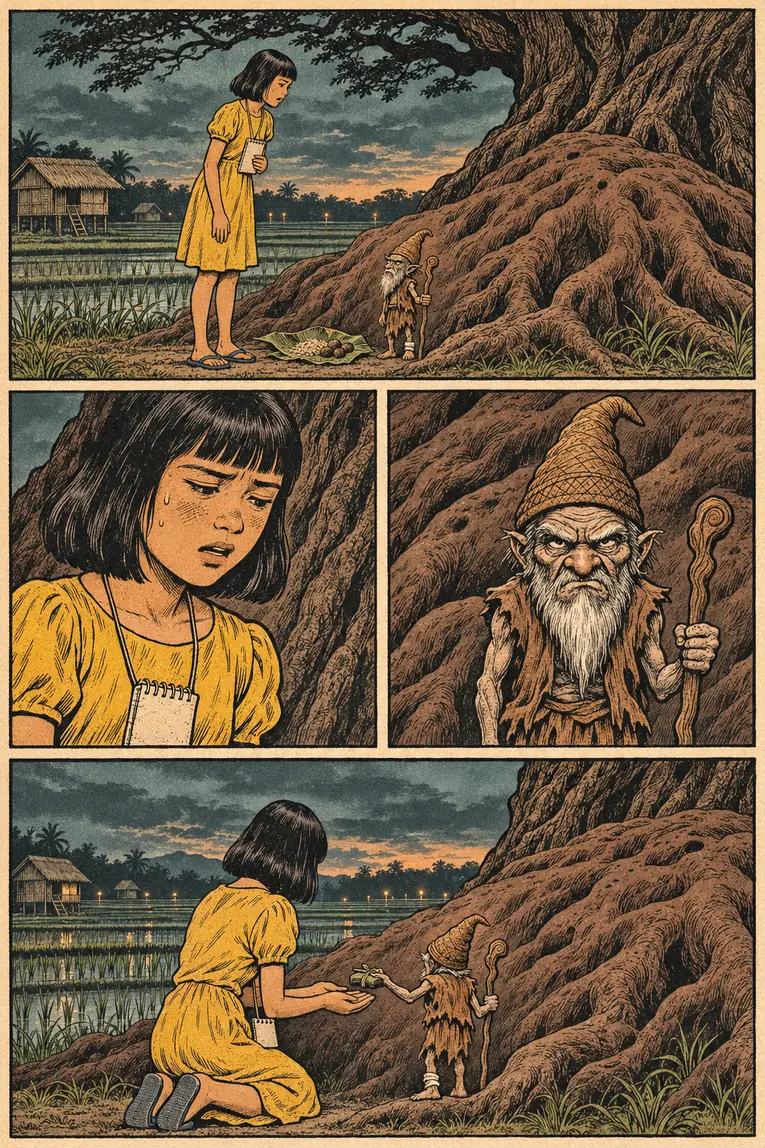
A door already open. Wide: dusk, outdoors at the foot of the termite mound under the black acacia, low orange light. Tinay stands in front of the mound facing it, out of breath, her notebook in her hand. The tiny nuno, no taller than a grown man's knee, stands on the lowest root facing her, his staff in one hand, his left ankle in the white handkerchief at our right, calm and watchful. At the foot of the root lies an old banana leaf with a clump of dry rice and a shrivelled fruit, untouched. Close-up: same place, same light. Only Tinay, looking down at someone off-panel, breathless and ashamed; behind her the dark trunk of the acacia; no other person. Close-up: same place, same light. Only the nuno, facing us, grim, his white brows low; behind him a strip of mound ridge; no other person. Low wide shot from behind them: the same place, the light fading. Tinay kneels at our left with her back to us, her feet and chest pointing at the mound, her hands cupped. The nuno stands on the root at our right, his back mostly to us, setting a small banana-leaf packet, no bigger than a matchbox and tied with a blade of grass, into her hands. Far across the dark paddies, tiny pin-point lamps stand still in a ring at the end of the dike.
In the old belief, a person who wrongs a nuno asks forgiveness and leaves an offering.Ayon sa paniwala, humihingi ng tawad at nag-aalay ang nagkasala sa nuno.
They want to crush you, po. Because of me.Gusto po nila kayong patayin. Dahil po sa akin.
The stakes woke my kin. I can't put them back to sleep.Ginising ng mga tulos ang mga kasama ko. 'Di ko mapatulog.
Take this. My kin will hear you.Kunin mo 'to. Pakikinggan ka ng mga kasama ko.
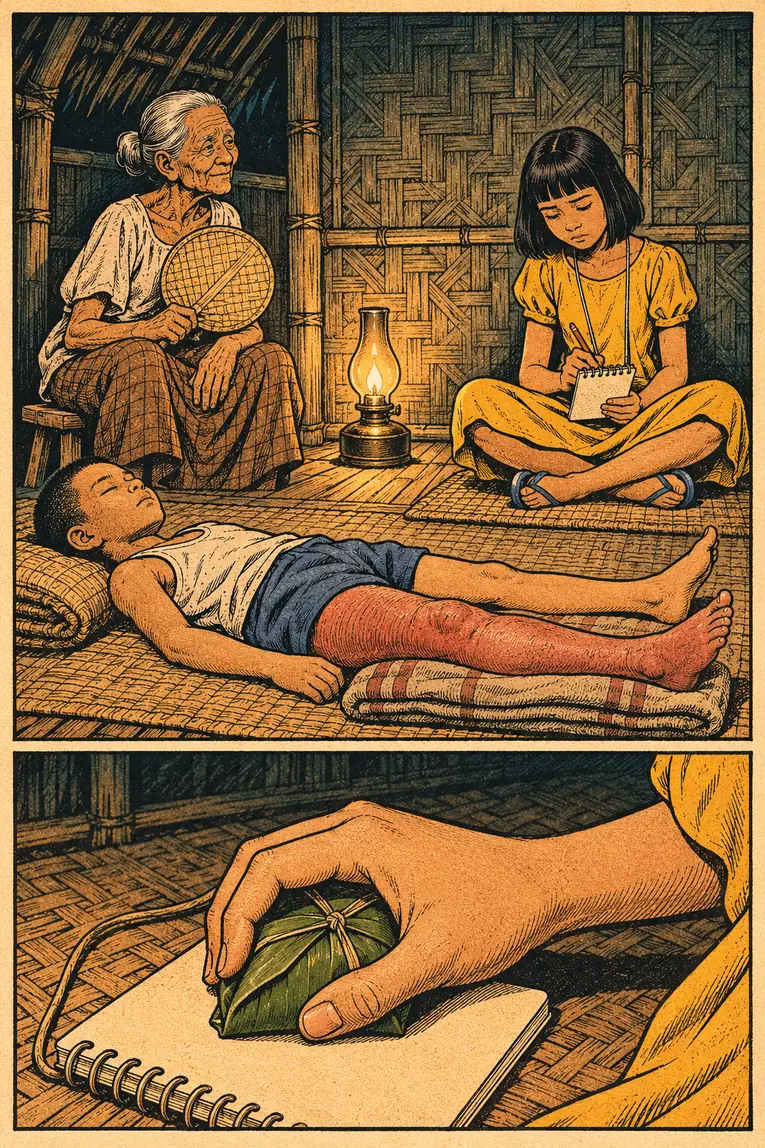
A reason. Wide: Monday night, inside the nipa house, an oil lamp on the floor. Tinay sits cross-legged on her mat at our right and writes in her notebook, tired and guilty. Boyet lies asleep on the next mat in the middle on his back, head at our left, his RIGHT leg, the one nearer to us, red and swollen to the thigh, straight and propped on a folded blanket. Lola Pacing sits on a low stool at our left behind his head with her woven fan, awake, watching Tinay, gentle. Close-up: same night, lamp light. Only Tinay's hand closing round the small banana-leaf packet tied with grass, over her open notebook; no face and no other person.
Still writing? It's late, apo.Nagsusulat ka pa rin? Gabi na, apo.
I showed them. Now they want him dead.Pinakita ko po sa kanila. Ngayon gusto nila siyang patayin.
I made him a promise, Lola. It's mine to keep.May pangako po ako sa kanya, Lola. Ako ang tutupad.
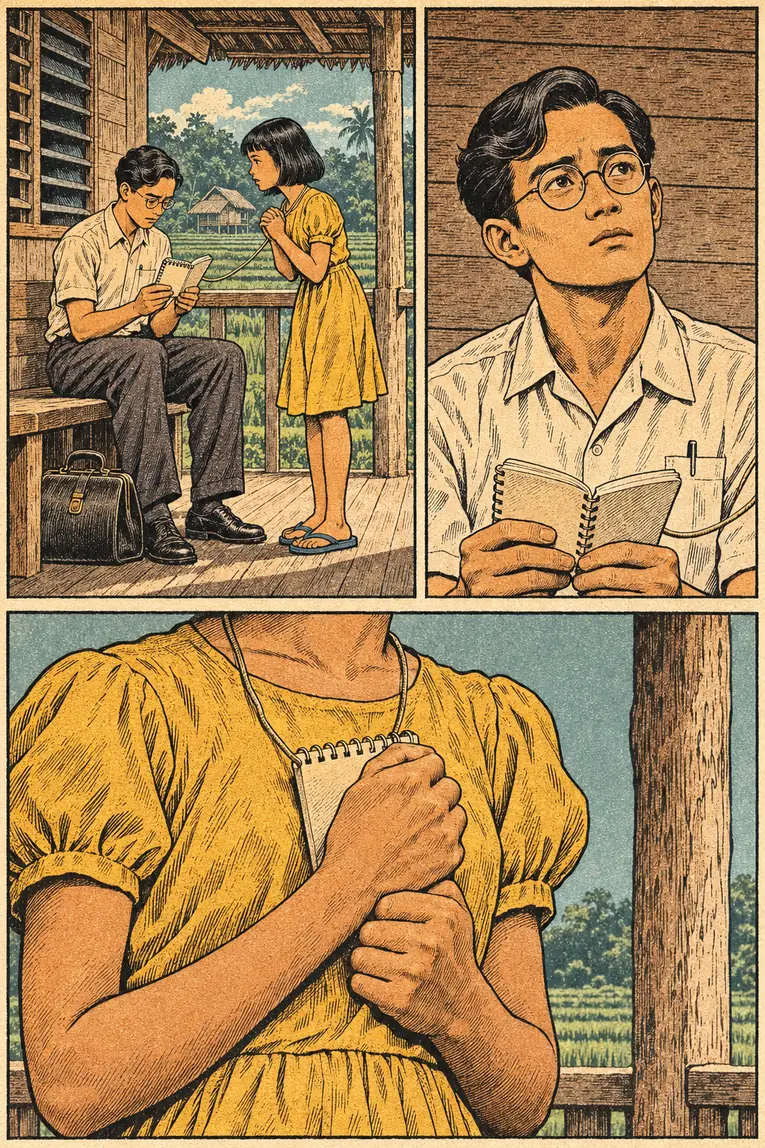
Not the nuno. Wide: Tuesday morning, outdoors on the porch of the small wooden barrio schoolhouse, bright light. Dr. Santos sits on a bench at our left reading Tinay's open notebook, his black bag at his feet, interested and serious. Tinay stands in front of him at our right, her hands clasped, her feet and chest pointing at him, pleading. Close-up: same porch, same morning. Only Dr. Santos, looking up from the notebook at someone off-panel on our right, honest and a little sad; behind him a plank wall; no other person. Close-up: same porch, same morning. Only Tinay's hands closing the notebook and pressing it to her chest, knuckles tight; behind her only a porch post; no other person.
Tell them, Doctor. It isn't the nuno.Sabihin n'yo po sa kanila, Doktor. Hindi gawa ng nuno.
Say iron, they laugh. Say nuno, I lose my license.Bakal? Pagtatawanan ako. Nuno? Babawian ako ng lisensya.
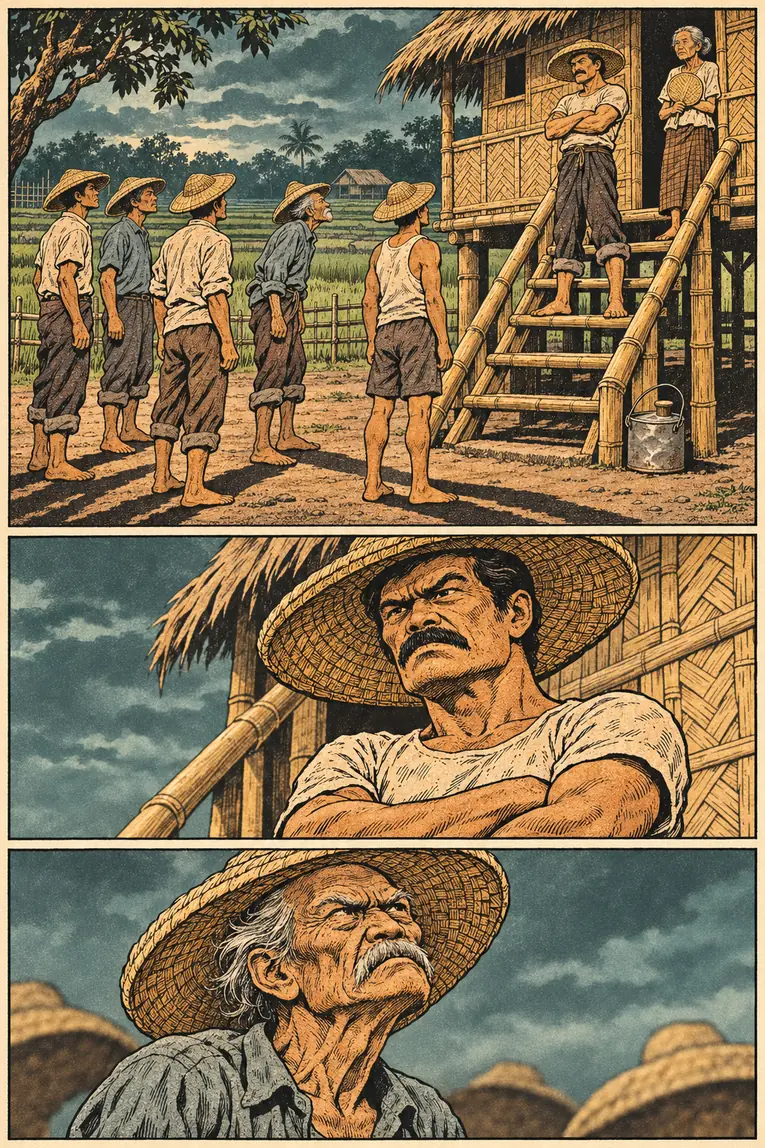
Fix it, Ramon. Wide: Tuesday, late afternoon, outdoors in the yard at the foot of the bamboo stairs of the nipa house, long shadows. A dented tin can with a wooden stopper stands against the stair post. Five farmers in straw hats stand in a half circle facing the house, the old farmer with the grey moustache at the front. Tatay Ramon stands on the third stair in his undershirt with his arms folded, facing them, grim. Lola Pacing stands at the top of the stairs with her woven fan, worried. Close-up: same yard, same light. Only Tatay Ramon, looking down at someone off-panel on our left, angry and worn; behind him the bamboo stair rail; no other person. Close-up: same yard, same light. Only the old farmer with the grey moustache, looking up at someone off-panel on our right, hard; behind him a blur of straw hats; no other person.
Ramon, your boy kicked it. Fix it.Ramon, ang anak mo ang sumipa. Ayusin mo 'to.
We left rice and fruit. He didn't touch it.Nag-iwan kami ng kanin at prutas. Hindi niya ginalaw.
Then do more, Ramon. Or we will.Kung magisip ka ng ibang paraan, Ramon. O kami na ang gagawa.
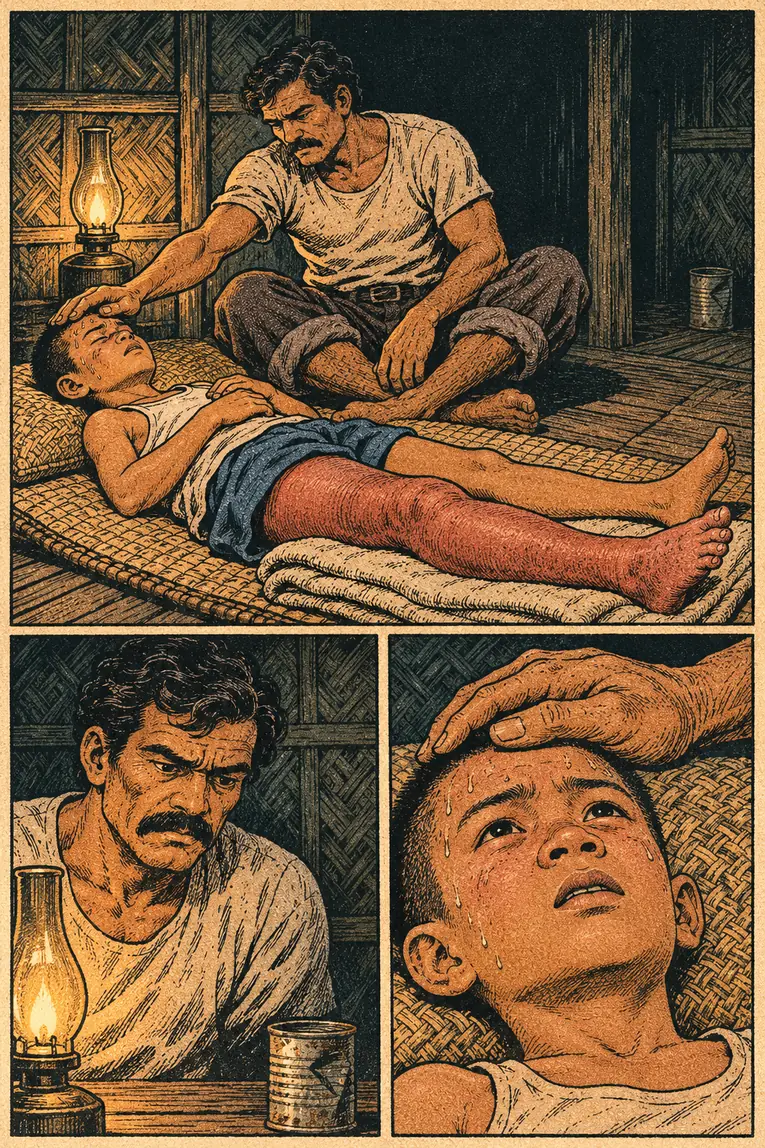
A father's hand. Wide: Tuesday night, inside the nipa house, an oil lamp on the floor. Boyet lies on his back on his mat, head at our left, eyes shut, his forehead wet with sweat, his RIGHT leg, the one nearer to us, red and swollen to the thigh, straight and still on a folded blanket. Tatay Ramon sits cross-legged at our right beside the mat, bare-headed, his hand on Boyet's forehead, worn out and afraid. Against the wall by the door, far at our right, a dented tin can stands in the shadow. Close-up: same night, lamp light. Only Tatay Ramon, bare-headed, his jaw tight, his eyes drifting past the lamp down to a dented tin can on the floor at the lower edge of the frame; behind him only the dark wall; no other person. Close-up: same night, lamp light. Only Boyet's face on the mat, his eyes open, flushed and scared, watching something above him off-panel, his father's hand; no other person.
Tay... it's so hot. My leg's on fire.Tay... ang init. Parang may apoy sa binti ko.
Sleep, anak. Tatay's here.Matulog ka, anak. Nandito si Tatay.
Tay, your hand's shaking.Tay, nanginginig ang kamay mo.
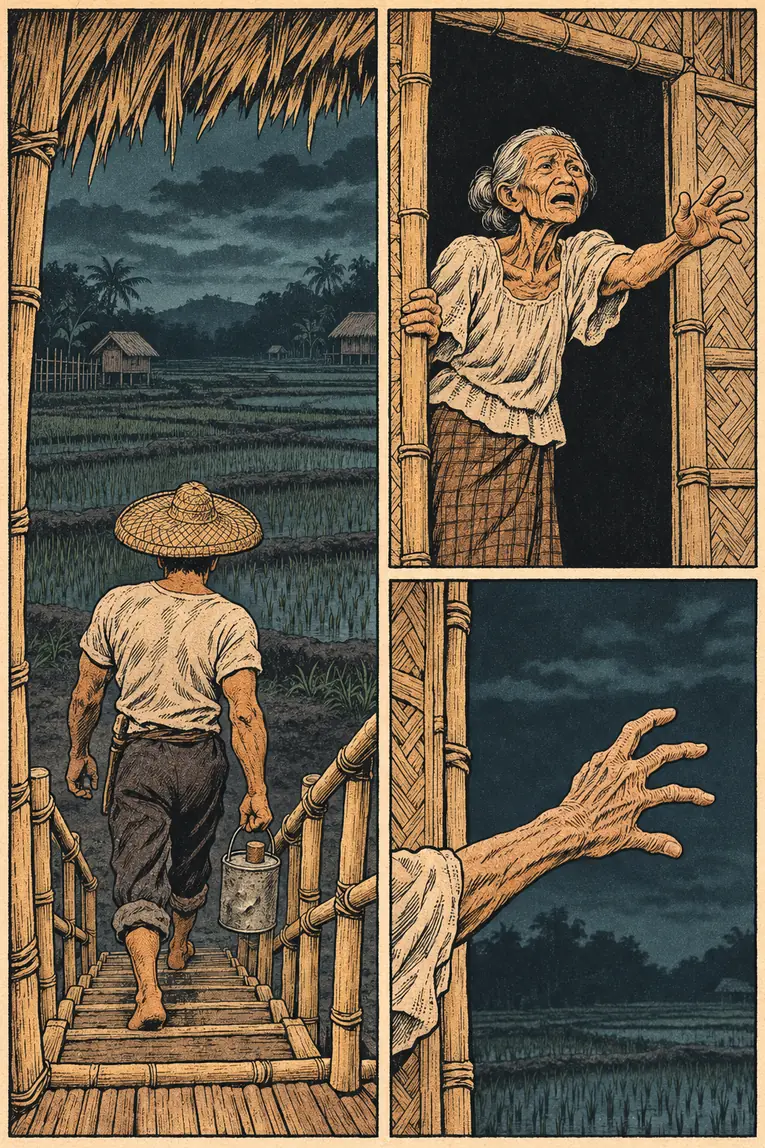
Before the cock crows. Tall: Wednesday, before dawn, outdoors at the top of the bamboo stairs of the nipa house, deep blue-grey dark. Tatay Ramon in his straw hat, seen from behind, goes down the stairs with a dented tin can in his right hand, his shoulders set and heavy. Close-up: same dark, the doorway of the nipa house. Only Lola Pacing, in the doorway in her loose white blouse, her hand lifted toward someone off-panel, calling, afraid; behind her the dark house; no other person. Close-up: same dark. Only Lola Pacing's hand, fingers open, reaching out of the doorway into the empty dark and closing on nothing; no face and no other person.
Ramon...Ramon...
The empty mat. Wide: Wednesday, grey dawn, inside the nipa house, thin light through the window slats. Tinay sits up on her mat at our right, her hair flat on one side, her notebook on its string, looking at her father's mat at our left: the blanket thrown back, the straw hat gone from its nail on the wall behind it. She is scared. Close-up: same dawn, inside the house. Only Lola Pacing, sitting by the open window with her woven fan still in her lap, looking at someone off-panel on our left, afraid; behind her the grey window; no other person. Wide: same dawn, seen through the window opening of the nipa house: the dark window frame in the foreground, and far across the grey paddies on a mud dike a small figure, Tatay Ramon in his straw hat, walking away from us with a tin can in his right hand, toward the black acacia and the mound. No one else in the picture.
Lola? Where's Tatay?Lola? Nasaan po si Tatay?
He took the kerosene, apo. I called him.Kinuha niya ang gaas, apo. Tinawag ko siya.
He didn't turn around.Hindi siya lumingon.
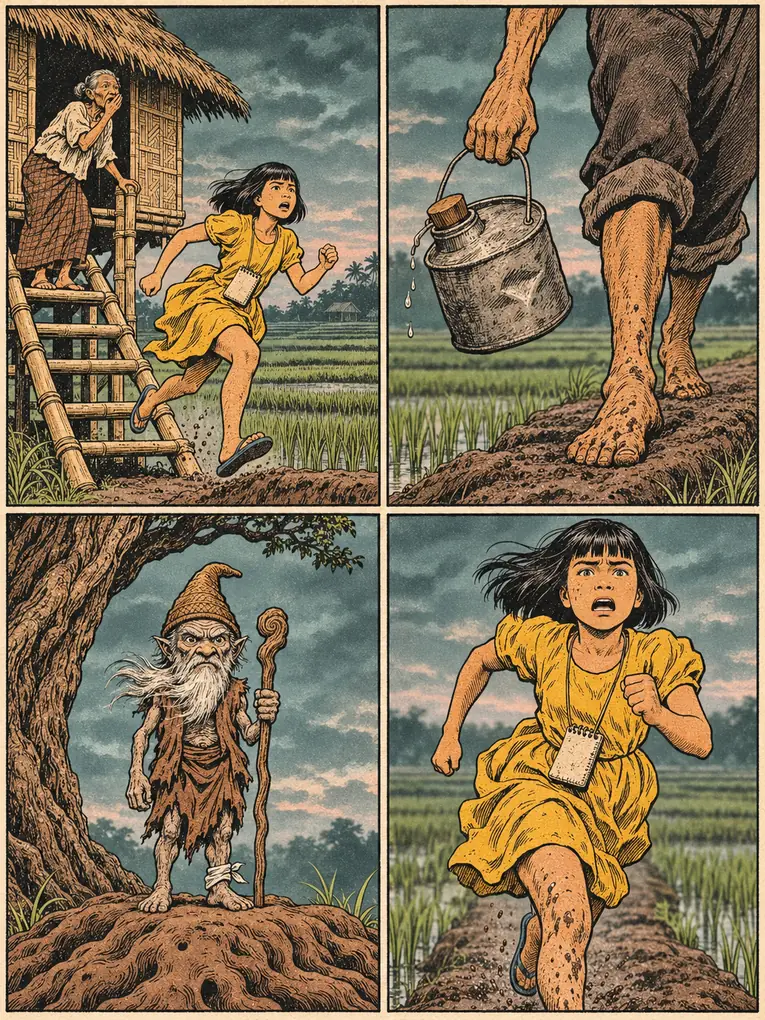
Faster. Wide: Wednesday, dawn, outdoors at the foot of the bamboo stairs of the nipa house, grey-pink light. Tinay jumps off the last stair and runs toward the dike, her feet and chest pointing at it, her notebook bouncing on its string, frightened. Lola Pacing stands at the top of the stairs with one hand pressed to her mouth, calling after her. Close-up: same dawn, outdoors on the mud dike. Only Tatay Ramon's right hand gripping the handle of a dented tin can, and his bare muddy feet on the dike; the can swings and a few drops spill from its spout; no face and no other person. Close-up: same dawn, outdoors. Only the nuno, standing on top of the mound facing us, his eyes opening wide, calm and not afraid, his white beard stirring in the wind; behind him the grey sky. Close-up: same dawn, outdoors on the dike. Only Tinay running toward us, mud on her legs, her hair flying and her mouth open, panting, terrified; behind her only the blurred green paddy; no other person.
Run, apo! Run!Takbo, apo! Bilisan mo!
SLOSH
So. The father comes, and not with rice.Ayan na ang tatay mo. Hindi ALAY ang dala.
I never ran so fast. It still wasn't fast enough.Ngayon lang ako tumakbo nang ganito kabilis. Pero kulang pa rin.
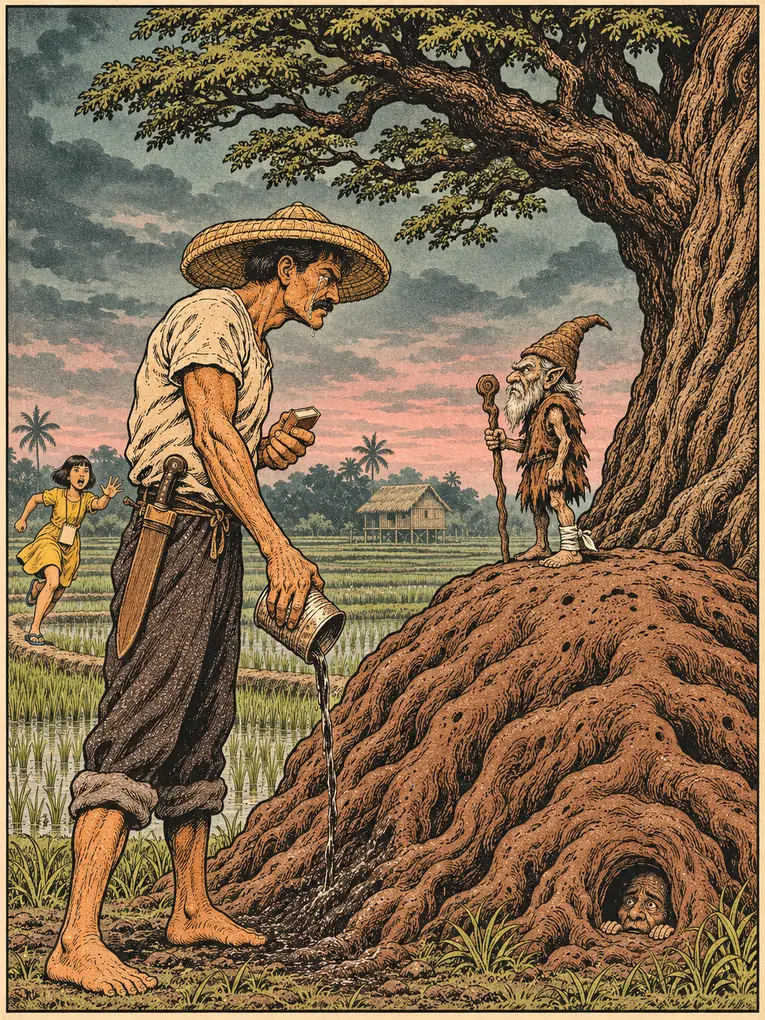
Fire or forgiveness. Splash. Wednesday, dawn, outdoors at the foot of the termite mound under the black acacia, grey-pink sky. Wide shot from the side. Tatay Ramon stands at our left facing right toward the mound, his straw hat on, a dented tin can in his right hand tipped so a dark wet streak runs down onto the earth at the mound's foot, a matchbox gripped in his left hand, his face wet with tears, grim and desperate. The tiny nuno stands on top of the mound at our right, facing left toward Tatay, his staff in his hand, his left ankle, the one nearer to us, in the white handkerchief, unafraid, his eyes fixed on the man. At the mound's foot, a small round door with a tiny frightened face peering out of it. Far behind at the left edge, small on the mud dike, Tinay runs toward them with her mouth open, shouting.
Tay, stop! Please!Tay, tigil po! Parang awa n'yo!
My son walks, or this mound burns.GAGALING ang anak ko, o masusunog ang punso.
End of Chapter 8.Katapusan ng Kabanata 8.

Next: Chapter 9, Tatay's Choice

Tinay stands between her father and the mound. Lola tells the story of her own father and the punso.

Read chapter 9

Sign in to bookmark this komiks and see when a new chapter is out.

What did you think of this chapter?

0 reactions

Comments 0

Sign in to comment.

Nobody has commented yet.